My three-year-old had been extremely cranky for weeks, and he would not sleep for long, not at night and not during the day. I was cooking, cleaning, and working, and managing him through all of it, usually with no help, for twelve hours or more at a stretch. It had been that way for about a year.
One afternoon my body simply stopped going along with it. I sat down, left everything where it was, and cried. The thought that came was simple: I cannot take it anymore, I cannot do it, and I am a bad parent.
Seven years of motherhood fell on me like a broken wall.
I cried until I felt numb. Then I told my sister, my mother, and my husband, and all three of them were there for me. None of them could take it off me for long, and it had to be me again.
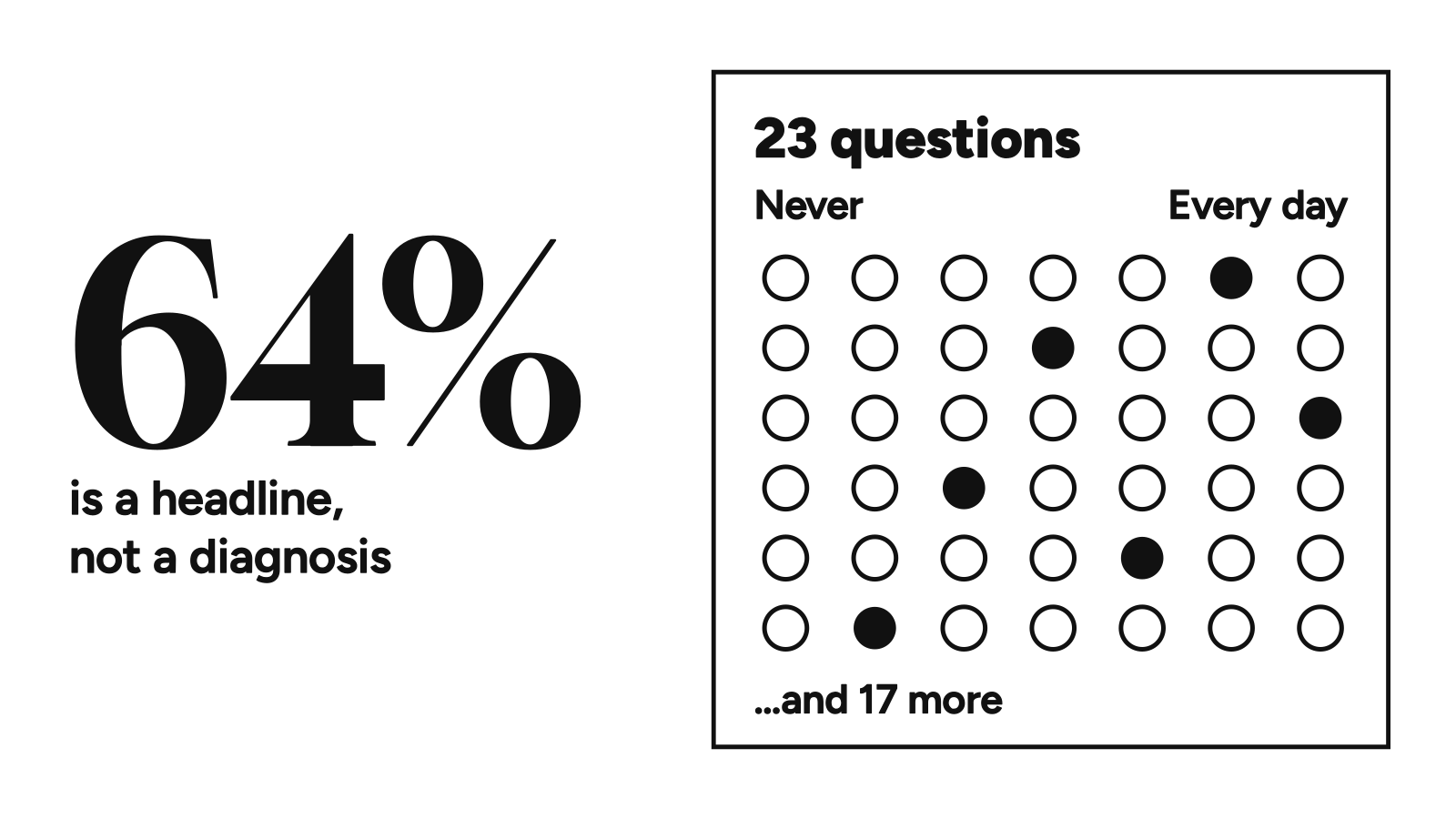
I am telling you this because of the headlines that arrived later: one announced that 64 percent of working parents have parental burnout, and another called it “depleted mother syndrome.” If you saw that number at midnight and thought, “that is me,” the exhaustion you recognized was real. The statistic itself is not a diagnosis, and it is not a verdict on what kind of parent you are.
Quick Answer
- Why headlines say 64% or 78%: Those numbers come from blog pages that name no test or sample behind them, not from clinical assessments.
- Depleted mother syndrome: A popular social-media name for mom burnout, the chronic caregiving overload and guilt that lands on a default parent, rather than a recognized medical diagnosis.
- Clinical parental burnout: Measured on a 23-question scale covering role exhaustion, emotional distance from your children, and losing the parent you used to be. Counted strictly across 42 countries, fewer than 1 in 10 parents crossed that line.
- What actually lowers it: Across 15 intervention studies, structured support programs brought burnout scores down and held the drop for up to three months. At home, tiny shared breaks beat waiting for a free weekend.
Parental Burnout vs Depleted Mother Syndrome: What Those 64% Headlines Miss
Three very different things get tossed into the same pot online, and knowing which one you are looking at takes some of the fear out of the room.
| Term | Where it comes from | What it actually measures |
|---|---|---|
| 64% and 78% burnout headlines | Viral workplace blogs | Unclear: no named test, sample, or questions |
| Depleted mother syndrome | Parenting blogs and social media | Everyday mental load, chronic tiredness, and mom guilt |
| Parental burnout | 23-item clinical scale (PBA) | Role exhaustion, emotional distance from your kids, and lost joy in parenting |
The 64 percent figure came from a page on The Education Echo that never names which study, which parents, or which questions produced it. A month earlier, the same site put the figure at 78 percent. Those two numbers cannot both be measuring the same thing in the same parents.
“Depleted mother syndrome” lands closer to daily life, which is why so many women type it into Google when they run out of bandwidth. As the Cleveland Clinic notes, it is not a recognized medical diagnosis: it is popular shorthand for what happens when one person holds the household’s entire mental to-do list, carries the guilt when anything slips, and never gets off shift. That load gets even heavier when paid work and childcare share the same four walls, which is part of why working from home is not the fantasy people sell.
What a Parental Burnout Scale or Quiz Actually Asks
Researchers who measure parental burnout properly ask far more than “do you feel burned out?”
In that 42-country study of 17,409 parents, Isabelle Roskam and her colleagues gave parents the 23-question Parental Burnout Assessment. Every question is scored by how often it happens, from never up to every single day: feeling completely run down by the parenting role, pulling away emotionally to save whatever energy you have left, losing enjoyment in being around your children, and barely recognizing the parent you used to be.
Counted that carefully, no country in the study reached even one parent in ten. In the United States, the rate sat between 7.9 and 8.9 percent depending on the cutoff used.
I am not telling you that so you can brush your tiredness off and keep going. Exhaustion does not have to pass a clinical cutoff to deserve help. I am telling you because a scary percentage with no questions behind it cannot tell you anything about your house: it can only tell you that you are tired, and you already knew that.
Parental Burnout Symptoms vs Ordinary Exhaustion
In clinical research, parental burnout is a sustained pattern rather than a terrible Tuesday. Ordinary exhaustion eases a little when you finally sleep or someone takes over for an afternoon; burnout settles in when the stress lasts long enough that you go on emotional autopilot with your kids and start doubting whether you are fit for the role at all.
I have taught clinical psychology for a decade. It did not keep me upright that afternoon in my living room. What my training gave me, once the worst of the crying passed, was a way to read the sentence that had been going around in my head.
“I am a bad parent” was not a finding about me. It was exhaustion talking.
The thought feels like an honest verdict on your character. In practice, it is what an overloaded mind says when it has been running twelve-hour shifts without relief, and it describes the weight of the load rather than the person carrying it.
The Advice That Did Not Help
Well-meaning people offered four familiar lines: all kids do that, this too shall pass, parenting is that hard, and you have made him too dependent, so give him space and he will outgrow it. None of those sentences took a single hour off my day.
The first three ask an exhausted parent to wait it out or accept it, and the last quietly blames her for being tired. When you already suspect you are failing your child, advice that agrees with that suspicion gives you one more reason to stay quiet and carry everything yourself.
What Actually Lowers Parental Burnout, According to 15 Studies
Structured support for burned-out parents has been tested, and the results are much more encouraging than viral crisis headlines suggest. That 2026 meta-analysis of 15 studies in the Journal of Affective Disorders found that across randomized trials, structured programs brought parental burnout down, and the improvement held up to three months later. Across very different formats, the effective programs shared two plain habits: parents learned what the exhaustion actually was, and they practiced steadying their own stress response.
What changed my own days was much smaller than a formal program, and no trial has tested my exact list. These are the five things that actually shifted the week for me.
1. Stop Carrying It Alone
My family could not take the whole load off me for long. What they could do was take it for twenty or thirty minutes, and short stretches turned out to matter. A brief break while my husband stepped in, or while my older son helped, did more for my week than any pep talk. Short help is still real help.
2. Use the Small Free Minutes You Already Have
I spent months waiting for a wide-open afternoon that was never going to show up. Once I stopped waiting for a three-hour break and started guarding the ten-minute pockets already sitting inside the day, my evenings stopped feeling like one unbroken shift. Ten minutes you actually rest beats an hour you keep postponing until Sunday.
3. Plan Tomorrow Tonight
Writing down tomorrow’s main tasks the night before helped more than I expected. Exhaustion wrecks decision-making in the moment, and every small choice you settle the evening before is one less thing to work out with a cranky three-year-old on your hip.
4. Settle Yourself Before You Try to Settle Your Child
Frequent tantrums wear a parent thin, and a worn-thin parent reacts faster and louder, which stretches the tantrum out even longer. I wrote about managing the wrong person’s feelings around phones, and the same loop runs here: you cannot reach inside a child and switch calm on, so your own reaction is the one lever in the room that belongs to you.
5. Taking a Day for Yourself Is Maintenance, Not Selfishness
Putting your own recovery first on hard days is how you stay able to show up the rest of the week.
If you are struggling to get through ordinary days, or if your thoughts about yourself or your family frighten you, bring that to a doctor or licensed mental health professional in person. If you ever feel you might hurt yourself or your child, contact your local emergency services or crisis line right away.
Where to Start Tomorrow
Ask one person in your life for one specific hour this week. Skip “I need more help,” which everyone nods at and forgets by dinner, and name the exact hour and the exact job: Thursday from five to six, bath or supper.
If nobody can take an hour this week, pick one ten-minute pocket tomorrow when your child is occupied and sit down before you touch the sink or your phone. It will not fix a hard year, and it does not need to.

Fariha Tariq
Fariha Tariq is a clinical psychologist who has spent most of her career on the research side of the discipline rather than the clinic. She earned both her BS (Hons) and her MS in Clinical Psychology from the Centre for Clinical Psychology at Punjab University, Lahore, where her master’s research examined how maladaptive schemas inherited from parents, combined with negative life events, shape antisocial behaviour in Pakistani adolescents.
She started out in research at the Department of Applied Psychology at Punjab University, and then in practice, as a clinical psychologist at a school for children with special needs in Lahore. In 2014 she joined the Department of Clinical Psychology at the University of Management and Technology, where she taught psychopathology, developmental psychopathology, school psychology, research methods, and statistical analysis, and ran the department’s programme at the Sialkot campus.
Over ten years she supervised thirty MS research projects and the clinical placements behind them—work that tracked what actually happens to people under pressure: adolescents living at the Line of Control, teachers burning out, nurses working through the pandemic, university students measuring themselves against their own photographs. Her published research appears in Psychiatria Danubina and the Journal of Muslim Mental Health, and she has reviewed manuscripts for Psychological Reports. She is currently a PhD scholar at Fatima Jinnah Women University.
At Tech Unbloated, Fariha covers the ground where technology meets the mind: screen time and the advice industry built around it, attention and sleep, what devices do inside a household, and the psychological cost hiding inside tools that promise to make life easier. She reads the study before she repeats the headline.
Discussion
Corrections, disagreements, and the thing I missed. Comments are read before they go up.
No comments yet. Go on—be first, and make it count.
Comments stay off until you say so.
Enable comments in cookie preferences to read and join the thread. No login. No ads in the box.