Evidence label: researched. Tech Unbloated did not test these tools for this piece. Every claim traces to a vendor page, a named study or an official document, listed at the end. Prices checked 4 November 2026.
A reference list where every entry has a working link is still not a checked reference list. That gap is what this guide is built around: what each tool can find, and what you still have to do yourself afterward.
I spent ten years teaching clinical psychology, research methods among the courses, so this is the advice I would give a student.
What Is the Best AI for Academic Research?
Use a free index to find papers, a claim-checker for one specific question, and a citation tool to see how later papers treated a finding. Pay only when a named limit stops you.
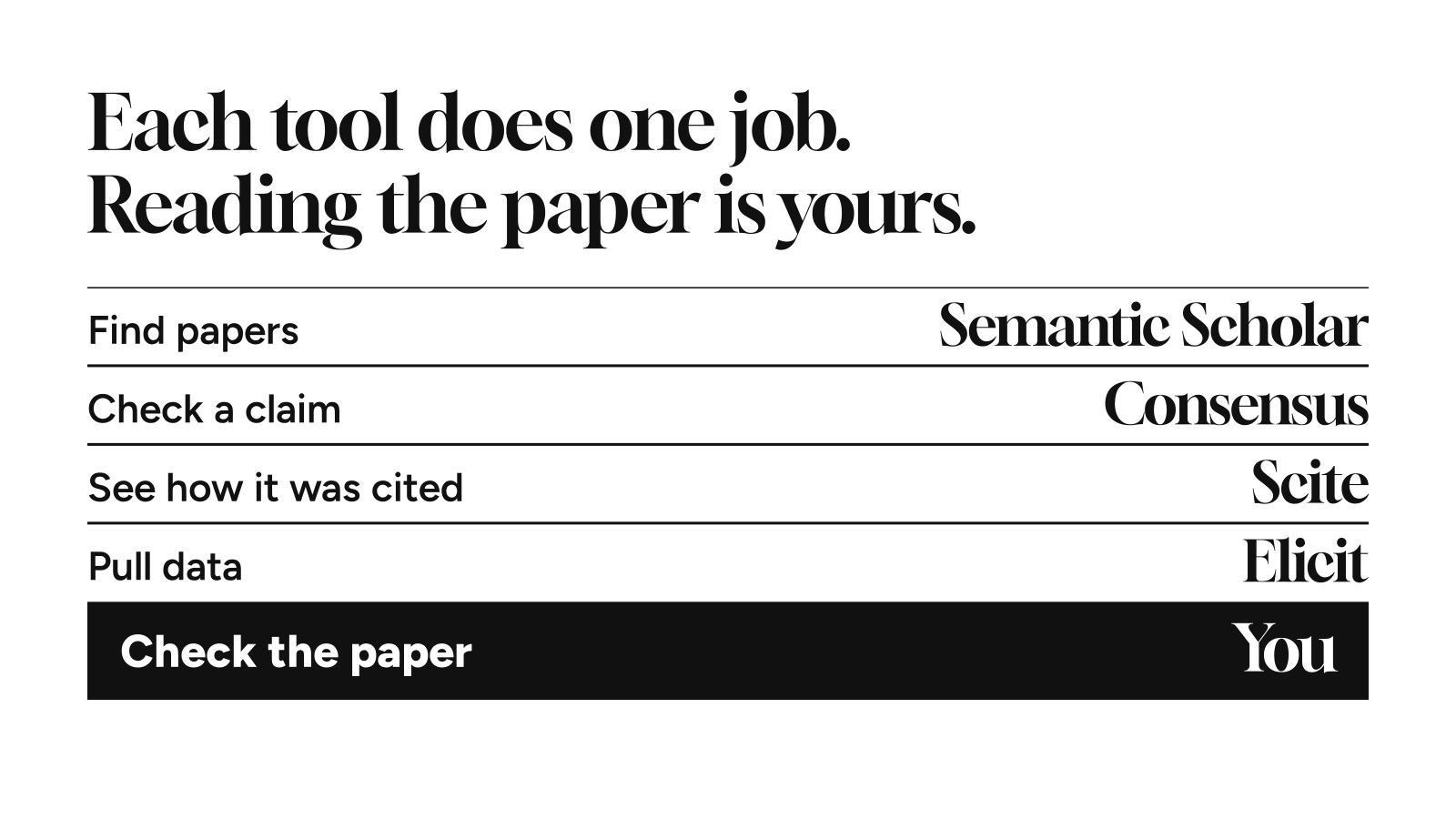
| Job | Tool | Cost | Worth knowing |
|---|---|---|---|
| Find papers | Semantic Scholar | Free | Run by Ai2, a non-profit. Says it indexes over 200 million papers. |
| Find papers | Google Scholar Labs | Free, limited access | Experimental. Limited to some signed-in users at launch. Current access not checked. |
| Find papers, deeper | Undermind | Free; Pro $16 a month billed annually, or $20 monthly | Its performance claims are its own benchmarks. |
| Check a claim | Consensus | Free; Pro $20 a month or $144 a year | Free tier: 10 Pro messages and 3 Deep reviews a month. Up to 40 percent off with a school email. |
| See how a paper was cited | Scite | 7-day trial, then $12 or $40 a month billed yearly | Cancel before day seven or the plan starts. |
| Pull data from papers | Elicit | Basic free; academic Plus $11 or Pro $39 a month billed annually | About half its extracted answers were accurate in one 2025 study. |
| Map related work | ResearchRabbit | Free; RR+ $10 a month billed annually, or $12.50 monthly | Free plan takes up to 50 seed articles. |
| Read your own PDFs | Gemini Notebook, formerly NotebookLM | Free with a Google account; paid Google AI plans raise the limits | 50 sources per notebook on the free plan. Renamed 16 July 2026. |
Do AI Research Tools Make Up Citations?
General chatbots did. The research tools above were tested differently, and what each study measured matters.
- Invented references. A 2023 study in Scientific Reports checked 636 references from ChatGPT-3.5 and ChatGPT-4. Of the GPT-3.5 references, 55 percent did not exist. Of the GPT-4 references, 18 percent did not exist. That is a chatbot writing from memory, not a research tool.
- Summaries that say too much. A 2025 study in Royal Society Open Science compared 4,900 summaries from ten language models with the abstracts and articles they summarized. Most stated results more broadly than the originals did, and three did it in 26 to 73 percent of cases.
- Missed papers and wrong data. A 2025 JMIR AI study tried to reproduce four published systematic reviews on glaucoma. Elicit did not find everything the manual method found, and its extracted data was accurate 51 percent of the time on average, with 14 percent imprecise, 22 percent missing, and 13 percent wrong.
- Conclusions drawn from abstracts. In a 2024 library test of Scite, Elicit, Consensus and Scopus AI, the arguments were generally supported. The librarians also saw conclusions drawn from the general lines of an abstract. It was one question, so it shows a pattern to watch, not a ranking.
Put together, the pattern is not that these tools fail. It is that they fail quietly. A missing paper leaves no gap on the page, and a summary that is slightly too broad reads just as smoothly as one that is right.
All of these tests used older versions of the tools, so none of them ranks today’s products.
Using AI for a Literature Review: Five Things to Stop Doing
1. Stop treating a tool’s list as the literature. Tools miss papers. Run the same question in Google Scholar, or Scopus or Web of Science if your library gives you access, and compare the two lists.
2. Stop reading the summary in place of the paper. Open the paper, find the sample and who it covers, and check that the tool claims no more than the authors did. Tech Unbloated has also covered what can happen to your own skills when AI does the thinking.
3. Stop trusting a reference list you did not look up. A link is a pointer, and it is not a check. Look each reference up in Google Scholar or your library catalog before it enters your bibliography.
4. Stop pasting extracted data into your table. Check a sample of rows against the papers: the first five is a fair start. If any are wrong, check the rest.
5. Stop leaving the tool out of your methods. Write one sentence naming the tool, the date, and the job you gave it. In Pakistan, the Higher Education Commission’s generative AI framework, notified on 4 September 2026, asks for a declaration of the tool and its purpose before the references, and a project or thesis undertaking that AI was not used to fabricate references or citations. Each university adapts it, so check your own university’s rules first.
The Smallest Next Step
Tonight, take the first three references your tool gave you and find each one in Google Scholar. Open the paper behind each. Read the sentence where the authors say what they could not show, and compare it with what the tool told you.
How This Was Checked
Prices come from the vendors’ own pages, read on 4 November 2026, using academic pricing where a vendor shows it. Not verified: current Scholar Labs access and student discounts other than Consensus’s. SciSpace is left out because its pricing could not be confirmed.
Sources
- Walters and Wilder, Scientific Reports, 2023. https://www.nature.com/articles/s41598-023-41032-5
- Peters and Chin-Yee, Royal Society Open Science, 2025. https://royalsocietypublishing.org/rsos/article/12/4/241776/235656/Generalization-bias-in-large-language-model
- Meliante and colleagues, JMIR AI, 2025. https://doi.org/10.2196/68592
- HKUST Library, 2024. https://library.hkust.edu.hk/news-events/news/trust-ai-evaluating-scite-elicit-consensus-and-scopus-ai-generating-literature
- Elicit pricing (academic view). https://elicit.com/pricing
- Consensus plans. https://help.consensus.app/en/articles/10087865-subscription-plans
- Consensus pricing. https://consensus.app/pricing/
- Scite pricing. https://scite.ai/pricing
- Undermind pricing. https://www.undermind.ai/pricing
- Semantic Scholar. https://www.semanticscholar.org/about
- Google, Scholar Labs, 2025. https://blog.google/outreach-initiatives/education/google-scholar-labs/
- Google Workspace Updates, Gemini Notebook, 2026. https://workspaceupdates.googleblog.com/2026/07/notebooklm-now-gemini-notebook.html
- Google, Gemini Notebook plans. https://support.google.com/gemininotebook/answer/16213268?hl=en
- ResearchRabbit pricing. https://www.researchrabbit.ai/pricing
- Higher Education Commission, Framework on Use of Generative AI Tools, 2026. https://www.hec.gov.pk/english/policies/Documents/Framework-Gene-AI.pdf
- Higher Education Commission, notification, 4 September 2026. https://www.hec.gov.pk/english/Notifications/Lists/Notifications/Attachments/62/HEC Notification AI Gen-AI-HEIs.pdf

Fariha Tariq
Fariha Tariq is a clinical psychologist who has spent most of her career on the research side of the discipline rather than the clinic. She earned both her BS (Hons) and her MS in Clinical Psychology from the Centre for Clinical Psychology at Punjab University, Lahore, where her master’s research examined how maladaptive schemas inherited from parents, combined with negative life events, shape antisocial behaviour in Pakistani adolescents.
She started out in research at the Department of Applied Psychology at Punjab University, and then in practice, as a clinical psychologist at a school for children with special needs in Lahore. In 2014 she joined the Department of Clinical Psychology at the University of Management and Technology, where she taught psychopathology, developmental psychopathology, school psychology, research methods, and statistical analysis, and ran the department’s programme at the Sialkot campus.
Over ten years she supervised thirty MS research projects and the clinical placements behind them—work that tracked what actually happens to people under pressure: adolescents living at the Line of Control, teachers burning out, nurses working through the pandemic, university students measuring themselves against their own photographs. Her published research appears in Psychiatria Danubina and the Journal of Muslim Mental Health, and she has reviewed manuscripts for Psychological Reports. She is currently a PhD scholar at Fatima Jinnah Women University.
At Tech Unbloated, Fariha covers the ground where technology meets the mind: screen time and the advice industry built around it, attention and sleep, what devices do inside a household, and the psychological cost hiding inside tools that promise to make life easier. She reads the study before she repeats the headline.
Discussion
Corrections, disagreements, and the thing I missed. Comments are read before they go up.
No comments yet. Go on—be first, and make it count.
Comments stay off until you say so.
Enable comments in cookie preferences to read and join the thread. No login. No ads in the box.