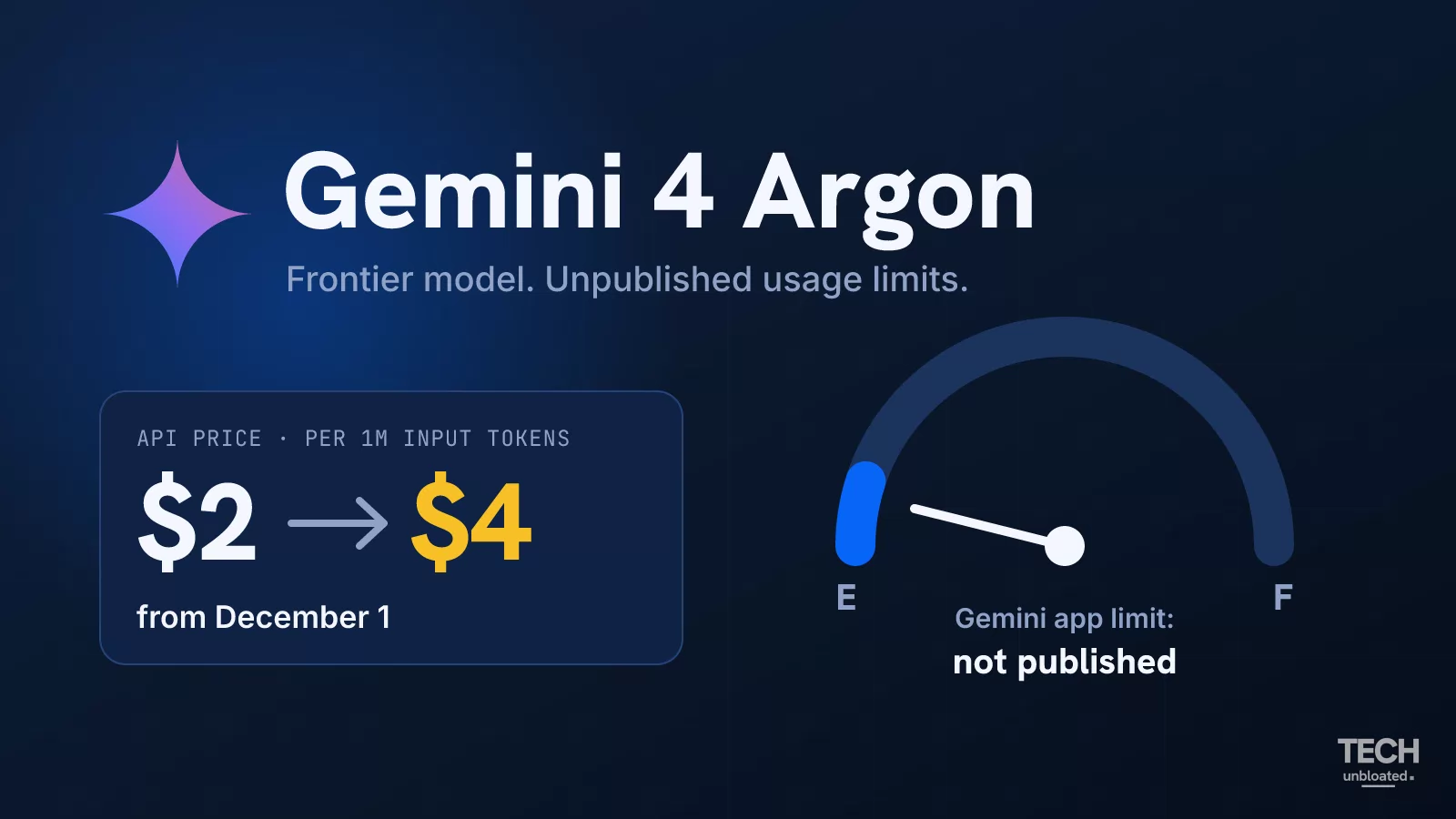
Google shipped a model that belongs at the frontier table. Then it handed you a teaspoon and called it a subscription.
In August I argued the empty Pro tier meant Google was aiming somewhere else. That piece was wrong. Argon is a straight shot at Anthropic and OpenAI—fired well, then priced and metered badly enough to lose the argument it just won.
Gemini 4 Argon at a Glance
| Benchmarks (Google’s table) | beats Claude Opus 5.5 on 14 of 18 |
|---|---|
| Independent index | Artificial Analysis: 53, level with GPT-6 Astra, behind Opus 5.5 (58) and Sonnet 5.5 (56) |
| API price | $2 / $10 per million tokens through November 30, then $4 / $20—Opus money |
| Gemini app limits | “compute-based,” refreshing every five hours up to a weekly cap. No prompt count published |
| Context window | 1M tokens, input and output combined |
Google got the model right. It got the usage limits so wrong that the model barely matters.
What Google Got Right
On Google’s own table, Argon posts 77.9% on DeepSWE, 91.9% on Vibe Code Bench, and 19.6% on Harvey’s Legal Agent Benchmark against Opus’s 3.8%—a gap that reads like a typo until you check it twice.
This isn’t Gemini 3.1 Pro with a new badge. Artificial Analysis scores it 23 points above 3.1 Pro on its Intelligence Index, and measured the lowest hallucination rate (15%) of any model scoring 45 or higher. Argon says “I don’t know” more often than its rivals. That’s rarer than it should be.
Its achievements are specific, too. Google linked the Chromium issue where Argon helped split a roughly 6 million-line legacy folder out of Chromium’s 40 million-line codebase, the ADK commit that cut long-session prep time by 40%, and the xTB changes that made molecular structure prediction up to 2.3x faster.
Vendors lie with charts. Commits are harder to fake.
And at launch pricing, Argon matches GPT-6 Astra’s index score at a fifth of Astra’s API price ($2 / $10 against $10 / $50).
Where the Table Stops Being Kind
| Model | AA Intelligence Index | API price per 1M in / out | Terminal-bench 4.0 |
|---|---|---|---|
| Claude Opus 5.5 | 58 | $4 / $20 | 66.4% |
| Claude Sonnet 5.5 | 56 | $2 / $10 | 70.6% |
| Gemini 4 Argon | 53 | $2 / $10, then $4 / $20 | 57.4% |
| GPT-6 Astra | 53 | $10 / $50 | 58.2% |
| GPT-6.1 Sol | 52 | $2 / $10 | — |
The index scores come from Artificial Analysis, the prices from each vendor’s pricing page as of October 21, and the Terminal-bench numbers from Google’s model card and Anthropic’s Sonnet 5.5 launch post.
After December 1, the model scoring 53 costs the same as the model scoring 58, and twice the model scoring 56. The discount is more of a grace period than a strategy.
The four tests where Opus beats Argon—FrontierSWE, Terminal-bench, Terminal-Bench Science, PostTrainBench—mostly ask the model to operate a machine rather than answer a question. In plain English, Argon writes the better plan and executes the worse one.
Independent testing found the same gap:
- The New Stack ran three head-to-head tasks. Argon tied Opus on a 3,500-line bug hunt at under half the cost. It then passed 11 of 80 tests on a billing spec because one early line passed an extra argument, and got the long-context dependency question wrong at every document size—answering in 243 to 425 tokens where Opus spent over 5,000, mostly reasoning. Fast and shallow, like the meme where a guy does quick but wrong math.
- Gert Labs placed Argon between Claude Fable 5 and Fable 5.1—“maybe 2 months behind the frontier”—and caught it in infinite reasoning loops, which it called the first time in a long while for a near-frontier model.
- Vals AI, the index Google’s launch post cited as “#1”: by October 19 it ranked Argon third, behind Sonnet 5.5 and Opus 5.5.
How Much Gemini 4 Argon Do You Actually Get?
| Where | Who gets Argon | Published limit |
|---|---|---|
| Gemini app | Google AI Pro ($19.99) and Ultra ($99.99 / $199.99) | none—Pro gets “4x” free limits, Ultra 5x or 20x Pro |
| Antigravity (Google’s coding IDE) | Ultra from October 13; paid Pro from October 15 | a separate “weekly-only” Argon quota, size unpublished |
| Workspace | only with an AI add-on | 200 or 500 prompts a day; core editions show N/A |
| Gemini API | paid tier only | pay per token |
| OpenCode Go ($10) | “Argon Contributor” variant | 220 requests per five hours (440 during a promo) |
Google publishes no prompt count for the app. Its help page says limits factor in prompt complexity, model and chat length, then refresh every five hours until an undisclosed weekly cap.
Then come the user reports—anecdotal, but too consistent to wave off. Pro subscribers on Reddit described Argon eating 5–10% of a five-hour window per prompt, running dry after around five prompts or about ten messages, and one product comparison taking 30% of a window.
I won’t convert a forum into a failure rate. But the same complaint, on the same tier and with numbers, is a pattern in the product, not an opinionated comment.
There’s a mechanical reason behind it. Artificial Analysis measured Argon generating 110 million tokens to finish its Intelligence Index, against a median of 82 million—about a third more verbose than the field, inside a system where every long thread re-reads its own history. Google built a model that thinks out loud, then metered you on compute.
Antigravity Turned Irritation Into Defection
On October 13, Gemini 3.1 Pro vanished from Antigravity for $20 Pro subscribers, who were left with Gemini 3.8 Flash while Argon sat behind Ultra. The complaints were immediate. One user said they’d already bought a Claude subscription. An Ultra subscriber wrote that if they have to pay Opus prices, they’d rather just use Opus.
Two days later, Google rolled Argon out to paid Pro with a separate weekly-only quota. It didn’t say how big. Pro accounts on promotional or carrier-bundled plans were still reporting no access on October 19 and 20.
You can reach Google’s best model more cheaply through someone else’s subscription than through Google’s own.
Not an alien claim. OpenCode’s $10 Go plan publishes 220 requests per five hours for its Argon Contributor variant. Different variant, different meter—and a reseller telling you more about the limit than the company that built the model.
What This Actually Is
Google fixed the hard problem. Argon is a genuine frontier model, a real jump from 3.1 Pro, and the first Gemini in years that belongs in a sentence with Opus without too much exaggeration.
What it broke is the part it has done well for twenty years: selling things. It launched at a discount it intends to withdraw, on a meter it won’t publish, behind a tier gate it walked back in two days, with a “#1 on the Vals Index” claim that didn’t survive the week.
The model earned a second look. The pricing page earned a cancellation. If the December increase stands and the quota stays secret, Google will have shipped its best model in years—and built the best case yet for running it somewhere else.

Ali Arslan
Ali began his journey as a full-time Tech Journalist in 2021. He’s been a tech enthusiast all his life, starting with a 286 PC gifted to him at the age of 7.
With time, he’s grown into a power user of Android, Linux, Windows, and all things AI, which are the main focus of his writing here at Tech Unbloated. He’s also got a proficient track record for bricking (and sometimes unbricking) Android phones while trying to push the hardware and software to their limits.
Ali has an Advanced Diploma in Business Management from London, UK, and is an English Literature graduate from Punjab University, Pakistan. Other than Tech Unbloated, he’s written for big tech publications like MakeTechEasier, MakeUseOf, How-To Geek, and LimeWire—however, most of his previous work was as a ghostwriter for high-profile clients.
Before becoming a full-time writer, Ali tried his luck at music production, graphic design, teaching, business management, web development, and dropshipping. His writing often reflects all these experiences he’s had in life.
Discussion
Leave a Mark
Corrections, disagreements, and the thing I missed. Comments are read before they go up.
No comments yet. Go on—be first, and make it count.
Comments stay off until you say so.
Enable comments in cookie preferences to read and join the thread. No login. No ads in the box.