I used to have tons of browser and terminal tabs open all the time, along with a dozen apps. Most of them were tools I signed up for rather impulsively. Claude. Gemini. Bandlab. Suno. HeyGen. Ableton. Capcut. Magnific.
I can’t tell you the last time I produced a single thing worth keeping out of any of them.
That’s the issue I want to dig into here—the one named in why more productivity tools can make you less productive that I’ve been quietly avoiding because it’s the most embarrassing of the bunch.
Tool hoarding. The compulsive collection of apps, agents, subscriptions, and browser extensions that never produce the work they promised to automate. The thing every productivity influencer is paid to promote. The thing every “Top 10 AI Tools” list quietly rewards.
I’ve since written down the rule that sits on the other side of that recommendation engine: commission rates never get to touch the ranking.
I’ve done it. You’ve probably done it. Most of the people retweeting “must-have stack” threads are doing it right now. And until we name it out loud, we keep doing it.
The Tab Economy
Here’s the loop, in seven steps, exactly the way it ran in my head for almost two years.
I open an app. I name a goal—an AI influencer I’ll launch, a book I’ll write, or a content pipeline I’ll finally build. The app suggests templates. I import data. I tweak settings. The dashboard gets filled. Things look promising.
Then I close the tab. I never return.
Two weeks later, I find a “better” app. I open it. I name the same goal. The cycle restarts. The original tool sits there charging my card every month while the goal sits in my head like a dying houseplant.
I called this “research.” I called this “finding the right system.”
I was lying to myself…
Every new tab was a fresh promise that this time the goal would be achieved—because the problem must be the tool, not me. Tools are easy to swap. Discipline’s expensive. So I kept swapping.
That’s the ‘tab economy.’ It runs on this exact substitution. You’re not procrastinating, you are “evaluating.” You’re not avoiding, you’re “exploring the potential.” Marketing teams have made it socially acceptable to dress avoidance up as research.
“Exploring the Potential” Is Procrastination With Better Branding
The phrase “exploring the potential of [NewestToolOnTheMarket]” should be banned from professional vocabulary.
Nobody’s exploring the potential of a tool. They’re doing the easy part of the work—onboarding, configuring, importing, watching the dashboard fill in with sample data—while skipping the hard part, which is the actual plan execution.
Onboarding feels productive. Your hands are moving. There are progress bars. There’s a checklist. There’s the dopamine of a green checkmark next to “Connect your accounts.”
But the only thing being built is a tool. The book’s not getting written. The AI influencer isn’t getting launched. The newsletter’s not getting sent. You’re decorating the workshop while the actual project rots in the corner.
I caught myself doing this for almost two years before I could even admit it. I’d tell my wife I was “working on the newsletter” when I was actually trying my fourth AI agent of the month. The newsletter had received zero sentences that day. The fourth AI agent had received four hours.
That isn’t work. That’s ‘geeky procrastination,’ and it cost me real years.
The Honest Audit
Here’s the exercise I ran on myself in March. Two columns, zero emotion.
Column A: Every tool, app, subscription, or AI service I’ve paid for in the last 18 months.
Column B: Every output worth showing another person that came directly out of that tool.
The numbers were brutal…
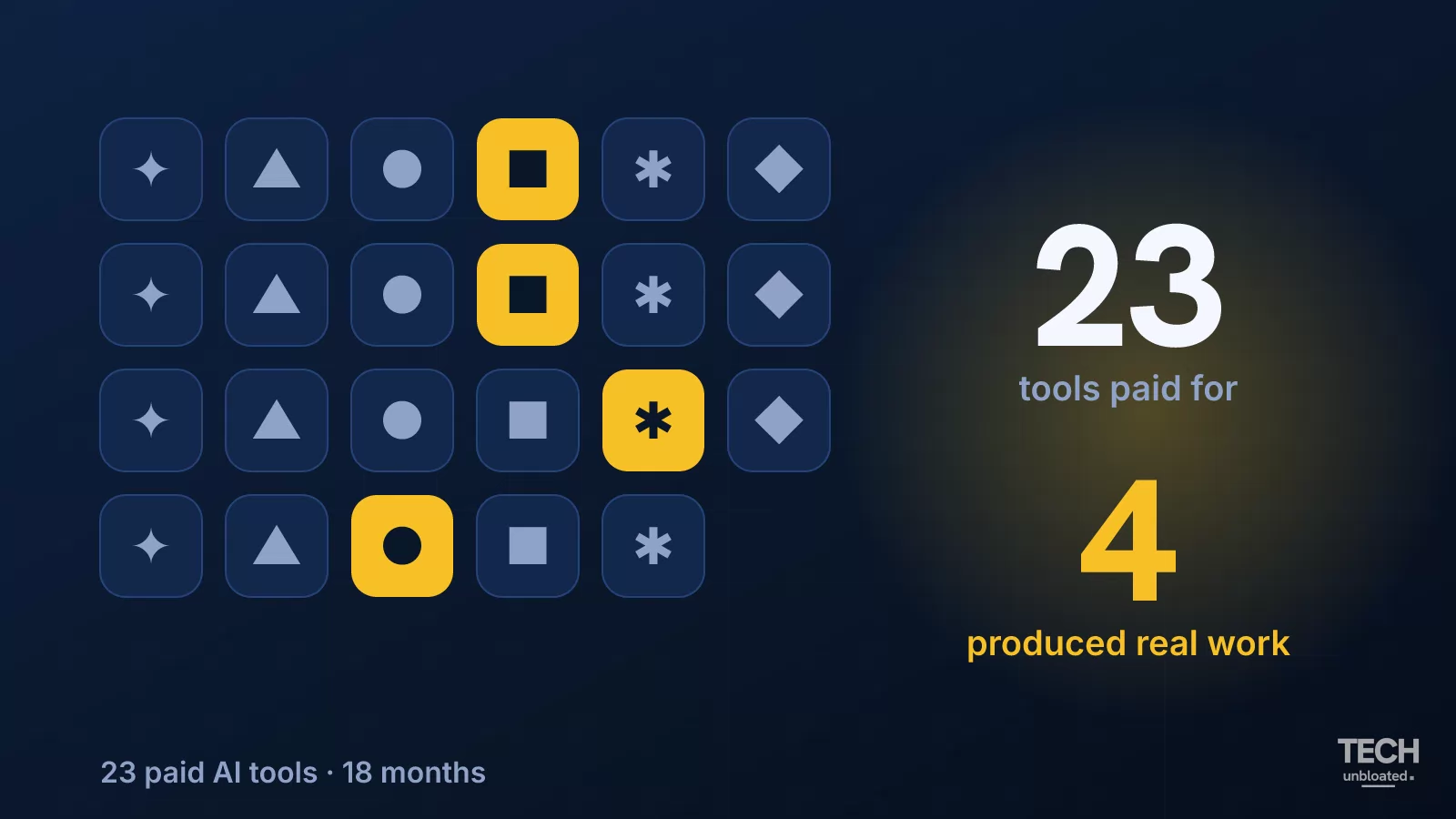
I’d paid for 23 tools. Of those, exactly 4 had produced anything I’d defend in public. Of those 4, only 2 were strictly necessary—the other two were nice-to-haves that somehow worked, but I could’ve shipped the same output in Google Docs and a notebook.
Nineteen of twenty-three paid tools were producing ambition. Plans. Templates. Dashboards. Workflows. Beautifully arranged drafts of stuff that never went anywhere.
If your tech garage is anything like mine was, run this audit. Write the two columns. Do not count “I’ll get to it.” Do not count “I had a great idea in this one.” If something hasn’t produced an output you’d send to a client, a reader, or your own publish button—it doesn’t count.
What’s left in Column B is what you actually need. Everything else’s a ‘museum of intentions’ with dead relics and souvenirs.
Rather see the prices before the questions? The finder also keeps every AI subscription compared side by side, cheapest plan to priciest.
The One-in-One-Out Rule
After the audit, I gave myself a hard rule.
No new tool enters my system until an existing tool leaves it.
That’s the whole rule. It might sound dumb, but it’s shockingly hard to stand by.
The reason it works is because it forces you to name what the new tool’s replacing. If you can’t name what’s leaving, the new tool’s not filling a gap—it’s filling a craving. Two very different problems.
Before a trial even reaches this rule, a brilliant app can still be wrong for your workflow gives you a four-line filter for deciding whether the problem existed before the demo.
This rule has saved me close to $1500 a year in subscriptions I’d have absent-mindedly piled up. More importantly, it forced me to actually use the tools I kept, because I’d just gone to the trouble of defending their seat in the tool collection.
The 30-Day Test
For tools that pass the One-In-One-Out filter, I give them 30 days. Inside that month, the tool has to ship at least one piece of real output—not a template, not a configuration, not a “this is going to be amazing once I…”—using the new tool.
If the 30 days end and no real output exists, the tool goes. No “I’ll give it another month.” No “the onboarding was tricky.” No “the founder just shipped a great update.”
The 30 days aren’t for the tool to win me over. They’re for me to prove the tool produces what I bought it for.
This is harder than it sounds, because the tool will keep promising. Every feature drop. Every “what’s new this week” email. Every founder post on X. The temptation to extend the trial is constant.
Don’t extend it. The whole point’s that the tool’s continued existence on your system costs you something—money, attention, mental space, and opportunity cost from the better-fitting tool you haven’t found yet because this one’s sitting in the seat.
The Question That Should Hurt
So here’s where I want to leave you.
Open a spreadsheet. Two columns. Tools you pay for, outputs they produced. Be honest enough to make yourself shudder.
The hardest row is the subscription you’ve defended in public for years. Mine is Gemini, and six empty months later I’m still waiting on the part that does the work.
Then ask the harder version of the question. Tool hoarding is one trap. There’s a second one I fell into right next to it—handing the actual thinking over to AI agents and calling that “delegation.” That’s a different issue: I let AI do the thinking. Then my skills started slipping.
For now, the question’s simpler, and it’s the only one that matters.
What are your tech subscriptions actually producing—and what would it cost you to admit the answer?

Ali Arslan
Ali began his journey as a full-time Tech Journalist in 2021. He’s been a tech enthusiast all his life, starting with a 286 PC gifted to him at the age of 7.
With time, he’s grown into a power user of Android, Linux, Windows, and all things AI, which are the main focus of his writing here at Tech Unbloated. He’s also got a proficient track record for bricking (and sometimes unbricking) Android phones while trying to push the hardware and software to their limits.
Ali has an Advanced Diploma in Business Management from London, UK, and is an English Literature graduate from Punjab University, Pakistan. Other than Tech Unbloated, he’s written for big tech publications like MakeTechEasier, MakeUseOf, How-To Geek, and LimeWire—however, most of his previous work was as a ghostwriter for high-profile clients.
Before becoming a full-time writer, Ali tried his luck at music production, graphic design, teaching, business management, web development, and dropshipping. His writing often reflects all these experiences he’s had in life.
Discussion
Leave a Mark
Corrections, disagreements, and the thing I missed. Comments are read before they go up.
No comments yet. Go on—be first, and make it count.
Comments stay off until you say so.
Enable comments in cookie preferences to read and join the thread. No login. No ads in the box.