The math in tech isn’t adding up right now.
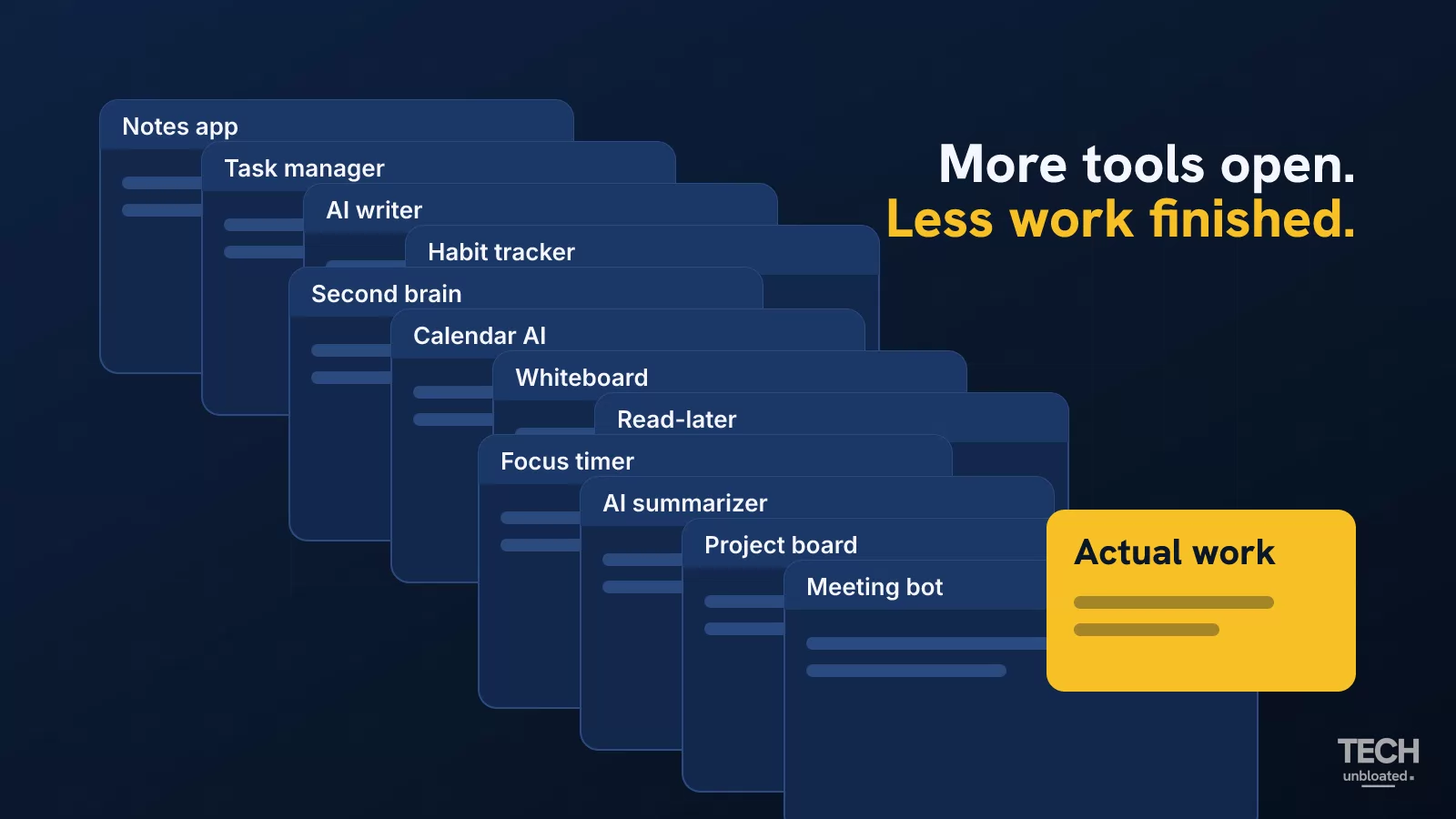
The more tools we own, the less we create. The more AI agents we hire, the less we achieve. The more “productivity” apps we fire up, the further behind we fall.
We’re bombarded with solutions that don’t solve. With cures that don’t heal. With expectations too outrageous.
I have had enough of this consumerism. We got to break this cycle or we’ll get run over by it. That’s why I’m starting this Tech Unbloated initiative.
The Promise We Were Sold
A decade ago, we dreamed of tools like the ones we have today. AI that drafts your emails. Apps that transcribe meetings, summarize PDFs, schedule your week, write your code, and recommend what you should eat for dinner. Some of what shipped in the last two years was beyond what most of us could even imagine in 2015.
That part’s real. The tech is genuinely incredible.
But the pitch came with an unspoken promise—that more capability would mean more output. That offloading the “boring stuff” would free us to do the meaningful stuff. That an inbox of AI assistants would translate into a calendar full of finished work.
For most people, that promise hasn’t delivered. And if you’re reading this and nodding along, you already know. You feel it. Your tool stack keeps growing and your output keeps shrinking, and somewhere in the middle of all that capability, the actual work is getting lost.
Saturation Is the New Bottleneck
Here’s the thing—when there were three good apps for any given job, you picked one and used it. You learned its quirks. You mastered it eventually.
Now there are three hundred tools at your disposal. And every Tuesday, ten more launch with bolder promises than the ones you tried last week.
The tech press doesn’t help. New launches get reviewed before anyone’s used them long enough to tell you whether they survive contact with reality. Affiliate posts go up the same day a product ships, written by people who watched a demo. Recommendations are stacked top to bottom on landing pages with no caveat about who the tool is actually for.
So you, the reader, end up doing what I did for two solid years. Subscribing. Trialing. Bookmarking. Switching. Migrating notes from one app to another every few months because something newer came along.
I called this “exploring the potential” of my tools. But really, it was just procrastination wearing a productivity costume. Embarrassing but true.
The over-saturation of solutions has become the very thing those solutions claim to fix.
The Confession Nobody Wants to Make
I’ll say it plainly—I do less today, with a dozen AI agents on call, than I did in 2019 with a notebook and a beaten up laptop.
That’s not a flex. It’s a problem. And the issue isn’t the tools—it’s me. Probably it’s you, too.
Each new subscription planted a new ambition in my head. A new “I’ll finally start the…” A new “this’ll be the year I…” None of those ambitions got finished. They got replaced by the next ambition the next tool seeded.
Tool hoarding doesn’t just waste money. It manufactures fake goals that crowd out the real ones.
This is what marketing has gotten very good at doing—selling you the version of yourself that would need the product, then leaving you alone with the bill when that version doesn’t materialize.
That’s the narrower trap I unpack in a brilliant app can still be wrong for your workflow: capability can be real while the fit is completely imaginary.
The dangerous word right now is “offloading.” We’re told to offload chores to AI, offload research to agents, offload writing, planning, scheduling, summarizing—offload, offload, offload.
Nobody finishes the sentence. Offload to what end? Free up time for what? If the answer is “to scroll more,” “to install more tools,” or “to watch the agents work”—congratulations, you’ve just made yourself the redundant part of your own workflow.
That’s not paranoia. That’s the logical endpoint of comfort without purpose.
What “Unbloated” Actually Means
Unbloated isn’t anti-tech. It isn’t anti-AI. It isn’t a Luddite cosplay or a romantic plea to go back to paper.
AI, used well, might be the best thing that’s happened to this industry in twenty years. Emphasis on used well, because that’s what’s lacking severely right now.
Unbloated is a stance against:
- Tools without a defined purpose in your week
- Marketing that manufactures needs you didn’t have
- Reviews written by people who never opened the product
- “Solutions” sold to everyone because narrowing the audience would shrink the addressable market
- Productivity theater dressed up as productivity
It’s a stance for:
- Picking the smallest set of tools that ships your actual work
- Measuring tools by output, not by features
- Telling the truth about what doesn’t work—even when there’s an affiliate payout attached to lying
- Treating “offloading” as a question, not an answer
That’s the whole thesis. It isn’t fancy. It’s just rare in the current tech landscape.
Tech Unbloated’s Stake in the Ground
A few promises about what you’ll find here, and what you won’t.
You won’t find next-day reviews of products nobody’s tested. You won’t find “best of” lists that exist because the affiliate payout is good. You won’t find vague “AI is changing everything” essays that say nothing.
You will find me trying tools long enough to know whether they survive a real workweek. You’ll find honest accounting of what failed, including the stuff I was paid to recommend. You’ll find writing that assumes you’re an adult with a job and a brain—not someone who needs to be sold the version of themselves who’d buy the product.
I’ll be honest about another thing, too: this is harder than it sounds. The economics of tech writing punish honesty. Affiliate payouts hit faster than real testing time allows.
That tension is why I wrote I make money from affiliate links. Here’s the rule I won’t break. Every list must say what I tested, what I researched, and commission rates never get to touch the order.
The temptation to take a press kit and run is real. I won’t pretend I’m above it. I’ll only promise I’m trying not to be that guy, and I’d rather you call me out when I slip than nod along.
The goal isn’t to give you another tool to add to your arsenal. It’s to help you finish what you already started—with fewer tabs open, fewer subscriptions running, and a clearer answer to the only question that matters.
What did you actually ship this week?

Ali Arslan
Ali began his journey as a full-time Tech Journalist in 2021. He’s been a tech enthusiast all his life, starting with a 286 PC gifted to him at the age of 7.
With time, he’s grown into a power user of Android, Linux, Windows, and all things AI, which are the main focus of his writing here at Tech Unbloated. He’s also got a proficient track record for bricking (and sometimes unbricking) Android phones while trying to push the hardware and software to their limits.
Ali has an Advanced Diploma in Business Management from London, UK, and is an English Literature graduate from Punjab University, Pakistan. Other than Tech Unbloated, he’s written for big tech publications like MakeTechEasier, MakeUseOf, How-To Geek, and LimeWire—however, most of his previous work was as a ghostwriter for high-profile clients.
Before becoming a full-time writer, Ali tried his luck at music production, graphic design, teaching, business management, web development, and dropshipping. His writing often reflects all these experiences he’s had in life.
Discussion
Leave a Mark
Corrections, disagreements, and the thing I missed. Comments are read before they go up.
No comments yet. Go on—be first, and make it count.
Comments stay off until you say so.
Enable comments in cookie preferences to read and join the thread. No login. No ads in the box.