Claude Pro and ChatGPT Plus both hit your card at $20. Cursor’s paid plans start at $8. So Cursor’s the cheap one, right?
Only until you want Claude in it. Take one fully used month of Claude Code, run the same tokens through Cursor’s credit, and by my math the $20 bill turns into about $1,208.
Sticker price is a terrible way to compare these three. Here’s what a month of coding costs on each tool, why Cursor bills other companies’ models differently, and which one fits your workflow.
Claude Code vs Codex vs Cursor: The Short Answer
- Claude Code gives you the most coding per dollar: On the $20 Claude Pro plan, SemiAnalysis measured ~2.9B tokens a month (~$1,178 in API value at Opus 5.5 rates) on an agent workload in its October 5, 2026 study.
- Codex is tighter at $20, and Pro ($100+) drops the 5-hour limit: OpenAI estimates 15–160 local messages per 5 hours on GPT-6.1 Sol on Plus, and SemiAnalysis measured ~1.0B tokens a month (~$211 in API value).
- Cursor ($8 Plus, $30 Premium) only includes Grok and Composer: Your weekly pool covers Grok 4.7, 4.6, and 4.5, plus Composer 2.5. Plus has no third-party models at all. On Premium and up, Claude, GPT, and Gemini always come out of prepaid credit at API list price.
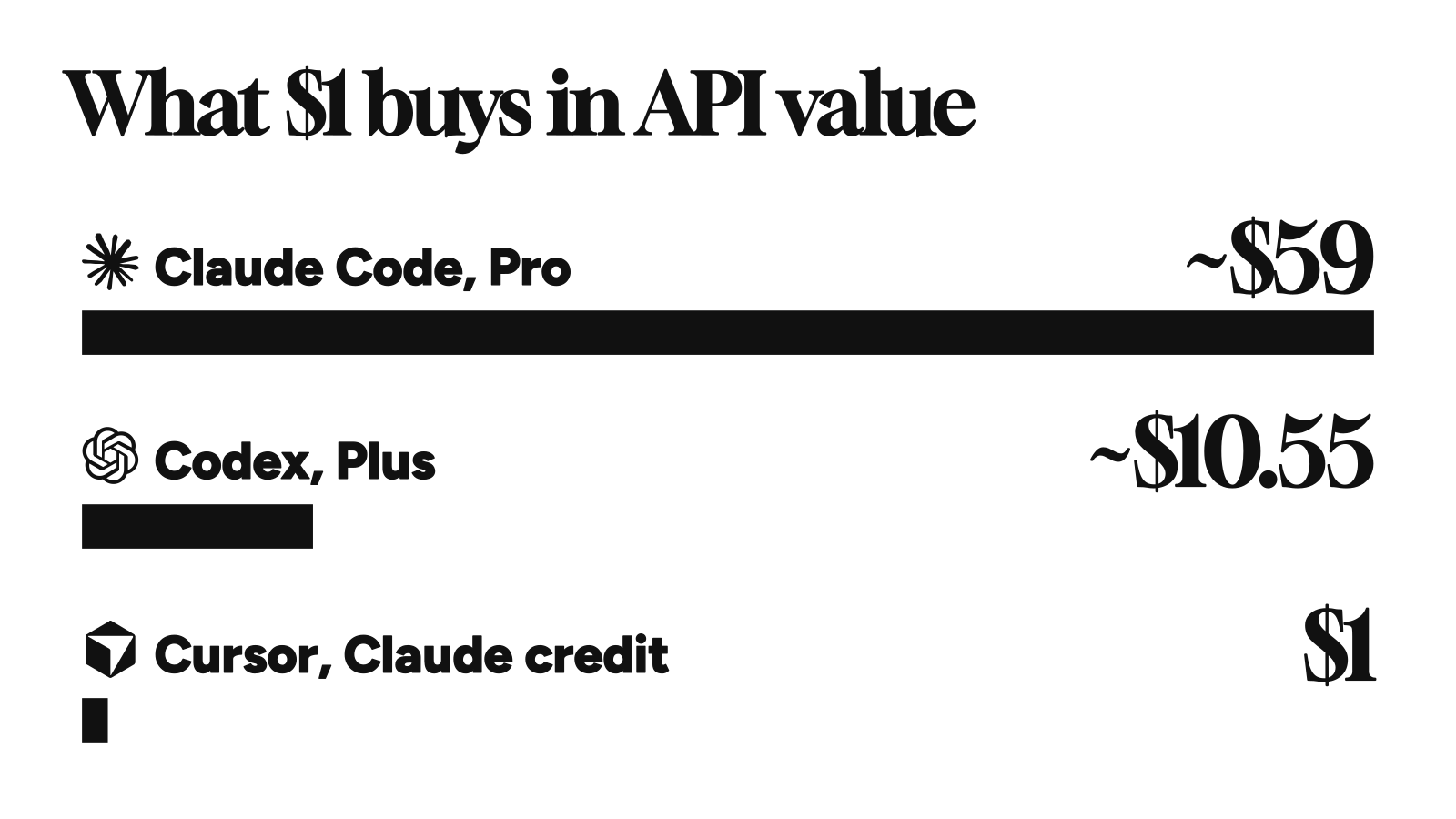
- For terminal agent loops, pay the model maker directly: $1 of Cursor credit buys $1 of tokens. A fully used Claude Pro plan returned about $59 of API value per $1.
Prices and plan mechanics from Anthropic, OpenAI, and Cursor pricing and docs pages, re-checked 2026-11-06.
| Tool and entry plan | Monthly price | Models included in plan | API-equivalent value per $1 | Third-party models |
|---|---|---|---|---|
| Claude Code (Pro / Max / Ultra) | $20 / $100 / $200 | Opus 5.5, Sonnet 5.5, Haiku 5.5 (+ Fable 5.1 on Max and Ultra) | ~$57.25–$58.90 (SemiAnalysis, agent workload) | Anthropic models only |
| OpenAI Codex (ChatGPT Plus / Pro) | $20 / $100 / $200 / $500 | GPT-6 Astra, 6.1 Sol, 6.1 Terra, 6 Sol, 6 Luna (Astra limited on Plus) | ~$10.55 on Plus; Pro tiers ~$10.42–$10.55 before October 29, about double that now (my estimate) | OpenAI models only |
| Cursor (X Subscription Plus) | $8 ($80/yr) | Grok 4.7, 4.6, 4.5, Composer 2.5 | ~$1 (my estimate) | Not available |
| Cursor (X Subscription Premium / Super / Ultra) | $30 / $100 / $200 | Grok 4.7, 4.6, 4.5, Composer 2.5 | $1 on third-party credit; pool is 4x, 15x, or 50x Plus on Cursor models | API list price from prepaid credit |
Cursor vs Claude Code: Which Costs Less for the Same Work?
For heavy agent work on Claude models, Claude Code costs a fraction of Cursor. Anthropic sells subscription usage far below its API rates. Cursor charges those API rates, so a Claude-heavy month gets no discount there.
Here’s the math. Cursor lists Opus 5.5 at Anthropic’s own prices ($4 in, $20 out per million tokens). Take the ~$1,178 month SemiAnalysis measured on Claude Pro, push the same tokens through Cursor Premium, and you pay $30 for the plan plus about $1,178 in credit. That’s about $1,208 against $20.
That’s my estimate, and it’s the ceiling case: a plan used to its limit all month, with the same token mix.
You probably won’t burn that much. Smaller months still favor Claude Code, because Premium costs $30 before your first Claude token and Pro costs $20 with the tokens included. At $100, Premium leaves you $70 of Opus credit. Claude Max returned about 80x that in SemiAnalysis’s numbers.
Cursor wins on cost only when you stay inside its own models:
- Cursor Plus ($8/month): Best if you want Cursor’s editor and you’re happy running Grok and Composer at fixed settings. I’ve paid for and used the $8 tier, and it’s an easy way in—as long as you don’t expect Claude or GPT in the bundle.
- Cursor Premium ($30/month): 4x Plus weekly usage, plus cloud agents, code hosting, and AI code reviews.
Both plans share that pool with Grok Chat, Voice, and Imagine, so a long night of image generation comes out of your coding week.
Codex vs Claude Code: What a Month Costs
Between the two model makers’ own agents, Claude Code stretches further at $20, while Codex on ChatGPT Pro is for developers who refuse to wait on a 5-hour timer.
At $20, Claude Pro gets about 2.9x the tokens of ChatGPT Plus in SemiAnalysis’s numbers. In API value the gap is roughly 5.6x, because Opus 5.5 costs more per token. OpenAI hasn’t changed Plus since.
At $100 and $200, both companies add monthly API credits and start removing the 5-hour limit:
- Claude Max ($100) and Claude Ultra ($200, formerly Max 20x): Max gives you 5x Pro usage every 5 hours and every week (SemiAnalysis measured ~14B tokens and ~$5,725 in API value on what was then Max 5x). Ultra gives you 10x Pro weekly usage and removes the 5-hour limit for verified accounts. Both include Fable 5.1 for up to half your weekly limit, plus $100 or $200 a month in Claude Platform API credits, which can’t be used in Claude Code.
- ChatGPT Pro 100, Pro 200, and Pro 500: Work and Codex allowance is 10x, 20x, and 50x Plus, with no 5-hour limit. On October 29, 2026, OpenAI doubled Pro 100 and Pro 500 and canceled a planned cut on Pro 200, so SemiAnalysis’s earlier numbers (~5.1B tokens and ~$1,055 on Pro 100, ~10.2B and ~$2,084 on Pro 200) undercount today’s allowance. Pro also comes with $100, $200, or $500 a month in OpenAI API credits. You have to claim them, they expire each billing cycle, and they don’t raise your ChatGPT or signed-in Codex limits or cover Codex through API keys.
Starting in December, OpenAI moves Plus, Pro, and Business to one token-based allowance across ChatGPT and Codex. Today Chat is separate. Instant chat won’t draw from the new allowance.
For the limits in detail, read Claude Pro vs ChatGPT Plus usage limits, ChatGPT vs Claude vs Gemini usage limits, and coding plan vs API: what a dollar buys.
Cursor vs Codex: Where the Money Goes
This one comes down to whether you’re paying for an editor or for OpenAI’s newest models in a CLI and cloud agent.
- Where Cursor puts your money: Tab autocomplete, Bugbot code reviews on Premium and up, and edits on Grok 4.7 and Composer 2.5.
- Where Codex puts your money: GPT-6 Astra and GPT-6.1 Sol in the terminal, IDE extension, web, and iOS, bundled with the rest of ChatGPT. Cursor’s model list stops at GPT-5.6, so GPT-6 isn’t on the menu there.
- The hybrid setup: Keep Cursor Free ($0) or Plus ($8) for the editor, and run Claude Code ($20) or Codex ($20) in its terminal. Your heavy multi-file refactors hit a $20 plan instead of list-price credit.
What Happens When You Hit the Cap
Each tool fails differently when a long refactor drains your quota:
- Claude Code (Pro / Max): You hit either the 5-hour session limit or the weekly limit, which resets at a fixed day and time assigned to your account. On my Claude Pro account I hit the 5-hour limit often and I’ve never hit the weekly one. The weekly limit covers every model, so switching models won’t get you past it. Claude Code may finish the step it’s on before it stops, though that wrap-up allowance is small, runs up to once a week on Pro, and is still rolling out. If you can’t wait, you can turn on usage credits at API rates ($4/$20 per million tokens on Opus 5.5, $2/$10 on Sonnet 5.5).
- Codex (ChatGPT Plus / Pro): On Plus, OpenAI’s estimates run 5–45 local messages per 5 hours on Astra, 15–160 on 6.1 Sol, and 350–3,000 on GPT-6 Luna, all from one allowance, and a weekly limit may also apply. At the limit, a turn already running can finish. After that you can buy credits, buy an instant reset if your account is eligible, or wait.
- Cursor (X Subscription): Once your weekly pool runs out, you can wait for the reset, keep going on prepaid credit at the same per-model rates, or upgrade. Cursor says requests are never downgraded. Top-ups last 365 days. On Premium and up, subagents can run a named third-party model while your picker still shows Auto, Grok, or Composer, and that bills to your credit.
Which One to Pay For
- Pay $20 for Claude Pro (Claude Code) if you want the highest ceiling per dollar and do most of your work in an agent loop, in the terminal or a VS Code or Cursor extension.
- Pay $20 for ChatGPT Plus (or $100 for Pro 100) for Codex if you want GPT-6 Astra and GPT-6.1 Sol, want published message estimates on the $20 tier, or want no 5-hour limit on the $100 tier.
- Pay $8 for Cursor Plus or $30 for Cursor Premium only if you want Cursor’s editor running on Grok 4.7 and Composer 2.5. Don’t buy Premium expecting it to cover a month of Claude Opus.
How This Was Checked
- For Claude, I read Anthropic’s pricing page and Use Claude Code with your Pro, Max, or Ultra plan. For Codex, I read OpenAI’s Codex pricing page, About ChatGPT Pro tiers, and Understanding ChatGPT and Codex usage limits. For Cursor, I read its pricing page, Models & Pricing docs, and Usage and limits help page. Cursor’s pricing card and docs disagree on Plus models, so I went with the docs.
- The value-per-dollar numbers for Claude and ChatGPT come from SemiAnalysis’s October 5, 2026 study, “Anthropic Subscriptions Offer 5x+ More Value Than OpenAI.” It measured an agent workload on Opus 5.5 and GPT-6.1 Sol, before OpenAI’s October 29 doubling, so its ChatGPT Pro numbers run low.
- I didn’t run one month through all three tools. The “same month” here is SemiAnalysis’s workload, and the Cursor dollar figures are my math from Cursor’s published rates.
- I’ve used Claude Pro (including Claude Code CLI), Claude Max when it was called Max 5x, ChatGPT Plus and Business, and Cursor’s $8 Plus plan. I’ve never used ChatGPT Pro. Claude Ultra, Codex, and Cursor’s higher tiers come from what the vendors publish.
Prices and limits move, so confirm at checkout. The best coding plan tool compares the rest, and the cheapest AI coding plans ranks them per dollar.
So which are you buying, the editor or the model? Pay for that one.

Ali Arslan
Ali began his journey as a full-time Tech Journalist in 2021. He’s been a tech enthusiast all his life, starting with a 286 PC gifted to him at the age of 7.
With time, he’s grown into a power user of Android, Linux, Windows, and all things AI, which are the main focus of his writing here at Tech Unbloated. He’s also got a proficient track record for bricking (and sometimes unbricking) Android phones while trying to push the hardware and software to their limits.
Ali has an Advanced Diploma in Business Management from London, UK, and is an English Literature graduate from Punjab University, Pakistan. Other than Tech Unbloated, he’s written for big tech publications like MakeTechEasier, MakeUseOf, How-To Geek, and LimeWire—however, most of his previous work was as a ghostwriter for high-profile clients.
Before becoming a full-time writer, Ali tried his luck at music production, graphic design, teaching, business management, web development, and dropshipping. His writing often reflects all these experiences he’s had in life.
Discussion
Corrections, disagreements, and the thing I missed. Comments are read before they go up.
No comments yet. Go on—be first, and make it count.
Comments stay off until you say so.
Enable comments in cookie preferences to read and join the thread. No login. No ads in the box.