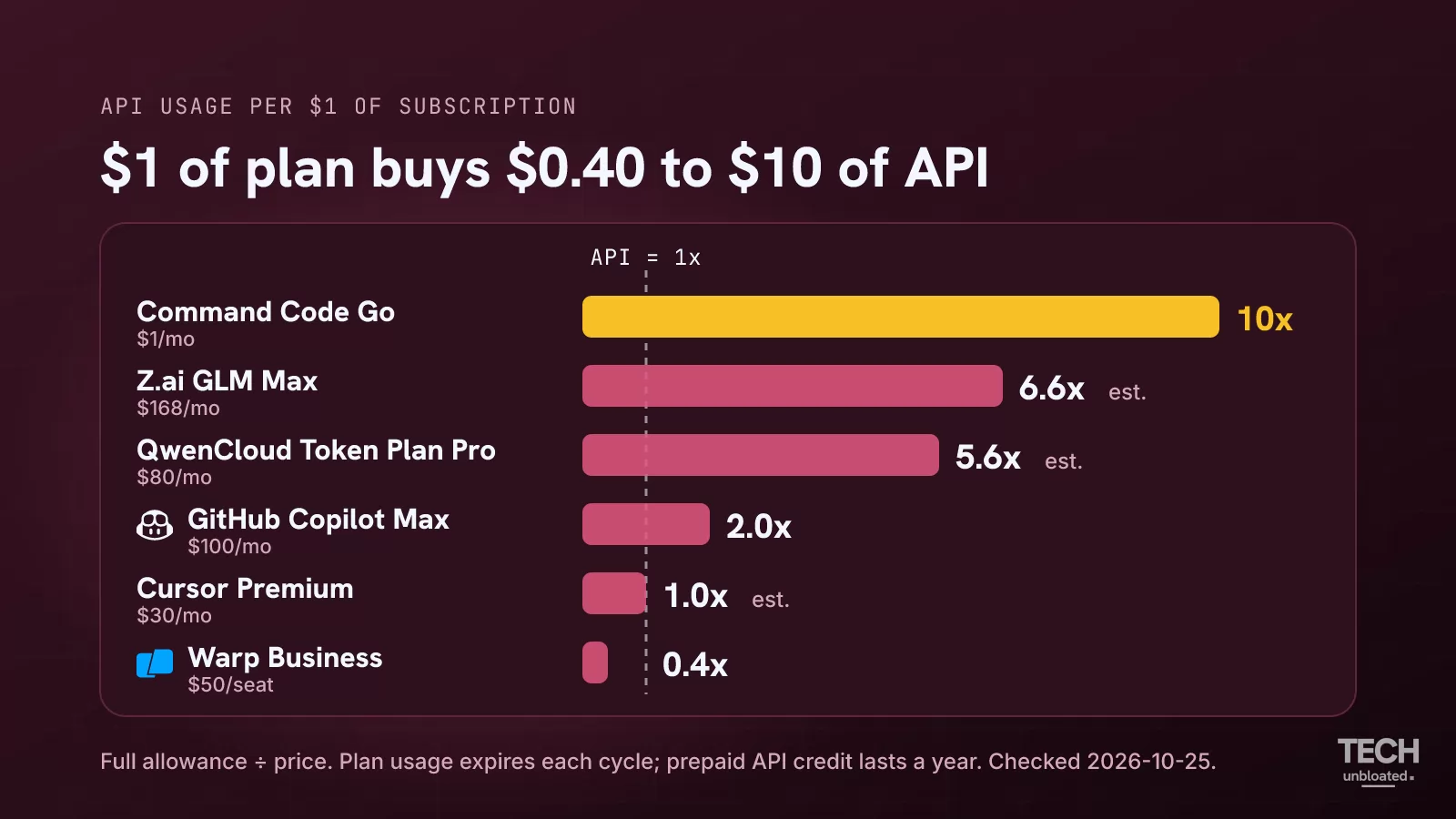
“Coding plan or API?” usually gets answered with rough estimates. But it has a number. Divide a plan’s published monthly usage allowance by its price, and you get how many dollars of API usage one subscription dollar buys.
Quick Answer
- A coding plan beats the API only when you use most of it. Across 15 plans from nine providers, $1 buys between $10 and $0.40 of API-priced usage.
- Best rates: Command Code Go (10x), OpenCode Go (up to 8x, on DeepSeek V4.1 Flash only), Command Code GOAT (7x or 8x during promotions), Z.ai GLM Max (6.6x, estimated).
- The biggest number isn’t in the table. Claude publishes no allowance, but SemiAnalysis measured Claude’s plans at about $58 of API value per $1, and ChatGPT’s at about $10.50.
- No discount at all: Cursor and Warp’s individual plans sit at 1.0x. A Warp Business seat is worse: 0.4x. You’re paying for the tool, not cheaper tokens.
- Bigger isn’t always better value. Some vendors give their best rate on the cheapest tier, others on the most expensive one.
- Plan usage expires. API credit mostly doesn’t. Every multiplier here assumes you burn the whole allowance before it resets. Prepaid API credit at OpenAI, Anthropic, or OpenRouter lasts a year.
Prices and allowances from official pages, re-checked 2026-10-25. Rows marked est. are estimates.
Is a Coding Plan Cheaper Than the API? 15 Plans, per Dollar
These 15 cover the best-known tools and the full range, from the best rate to the worst. Want every plan? The AI coding plan guide compares all of them by workload, and the cheapest AI coding plans covers everything from $1 to $20.
| Plan | Price/month | Usage included | Per $1 | Meter |
|---|---|---|---|---|
| Command Code Go | $1 | $10 pool | 10.0x | dollar pool |
| OpenCode Go | $10 | $15–$80, set per model | 1.5–8.0x | dollar pool |
| Command Code GOAT | $10 | $70 pool (pricing card now says $80) | 7.0x | dollar pool |
| Z.ai GLM Coding Plan Max | $168 | ~$1,105 (est.) | 6.6x | credit pool |
| Z.ai GLM Coding Plan Pro | $80 | ~$473 (est.) | 5.9x | credit pool |
| QwenCloud Token Plan Pro | $80 | ~$450 (est.) | 5.6x | credit pool |
| Z.ai GLM Coding Plan Lite | $18 | ~$79 (est.) | 4.4x | credit pool |
| QwenCloud Token Plan Lite | $8 | ~$29 (est.) | 3.6x | credit pool |
| GitHub Copilot Max | $100 | $200 of credits | 2.0x | credit pool |
| Kiro Pro | $20 | ~$40 (est.) | 2.0x | credit pool |
| Command Code Max 20x | $200 | $300 pool | 1.5x | dollar pool |
| Kilo Pass Pro | $49 | $49 in credits + 10–50% bonus (~$54–$74) | 1.1–1.5x | dollar pool |
| Cursor Premium | $30 | ~$30 (est.) | 1.0x | dollar pool |
| Warp Build | $20 | $20 at API rates | 1.0x | pass-through |
| Warp Business | $50 per seat | $20 at API rates | 0.4x | pass-through |
Five footnotes that change the math:
- GitHub Copilot’s allowance is only partly fixed. Pro’s $15 is $10 of base credits plus a $5 “flex allotment” that GitHub says can change as model prices move. Pro+ is $39 + $31, Max $100 + $100.
- OpenCode Go’s rate depends on the model you pick. Each model gets its own monthly dollar limit, and every request counts against one shared allowance as a share of that model’s limit. On the $10 Go plan, DeepSeek V4.1 Flash gets $80 a month (8x), MiniMax M3 and GLM-5.3-Flash get $60 (6x), and frontier models like GLM-5.3, Kimi K3 and Grok 4.7 get $15 (1.5x). Any 5-hour window can use 20% of the month, any week 50%. In practice that gap is huge: one small Kimi K3.1 Pro chat through OpenCode Go in Hermes hit my 5-hour limit, while on DeepSeek V4.1 Flash I find the cap almost impossible to reach.
- Kilo’s bonus depends on the month, and it only comes after you spend. Monthly plans add 10% in month 1, 50% in month 2, then up to 40% as your streak grows; annual plans add 50% every month. The bonus arrives only once you’ve used the paid credits, and it expires at the end of that monthly cycle.
- QwenCloud doesn’t put a dollar value on its credits, but its own docs let you work one out. A worked example in the Token Plan docs bills qwen3.6-plus at 5,000 input tokens, or about 830 output tokens, per credit. At that model’s list API price ($0.50 in, $3 out per million tokens), a credit comes to about $0.0025 either way. The table uses that rate and list prices. At today’s limited-time prices ($6 for Lite, $68 for Pro), they run 4.8x and 6.6x. QwenCloud’s pricing page itself only promises “around 40% off” pay-as-you-go, so treat these rows as the optimistic end.
- Claude, ChatGPT, Kimi and MiniMax aren’t in the table. They sell usage windows and publish no dollar figure, so there’s no published allowance to divide. Claude and ChatGPT have been measured, though: SemiAnalysis put Claude’s plans at about $57–59 of API value per $1 and ChatGPT’s at about $10.50 (the full numbers). If those hold, Claude Pro beats every plan in this table. Kimi Code ($19 to $199) caps a rolling 5-hour window and a monthly total; MiniMax’s Token Plan ($22 to $132) caps 5-hour and weekly windows. Neither puts a number on either. Claude Max does now add $100 (Max 5x) or $200 (Max 20x) of monthly API credit, but it pays for apps you build on the Claude API, not for interactive Claude Code—and it expires at the end of each billing cycle.
Is a Bigger Tier Better Value? Depends on the Vendor
Read each vendor’s ladder from cheapest tier to most expensive, including the tiers the table above leaves out:
| Vendor | Per $1, cheapest → priciest tier | Pattern |
|---|---|---|
| Command Code | 10x → 7x → 4x → 1.5x → 1.5x | best rate at the bottom |
| OpenCode | 1.5–8x → 1.5–6x, by model | cheap models do best on Go; GLM-5.3 doubles on Go Plus |
| Z.ai | 4.4x → 5.9x → 6.6x (est.) | best rate at the top |
| QwenCloud | 3.6x → 4.0x → 4.5x → 5.6x (est.) | best rate at the top |
| GitHub Copilot | 1.5x → 1.8x → 2.0x | best rate at the top |
| Kiro | 2.0x on every tier (est.) | flat |
| Cursor | 1.0x on every tier, Teams included (est.) | flat, no discount |
| Kilo | 1.1x–1.5x on every tier, set by the bonus month | flat |
So the upgrade question has no general answer. On Z.ai and QwenCloud, upgrading buys cheaper usage. On Command Code, the $1 plan is the best rate the company sells, and every upgrade buys more room at a worse rate.
Our read on why (interpretation, not something any vendor states): a credit pool with a hard cap lets the vendor limit its own risk, so it can discount the big tiers. A dollar pool hands out real dollars of usage, so the subsidy goes where the dollars are small.
Coding Plan vs Token Plan: What’s the Difference?
| Meter | What you buy | Who sells it | Can you price it? |
|---|---|---|---|
| Window plan | a share of usage per 5-hour, weekly or monthly window | Claude, ChatGPT, Kimi Code, MiniMax | no—no dollar figure published |
| Credit pool | a vendor currency with a published exchange rate | Z.ai, QwenCloud, Kiro, GitHub Copilot | yes, through the formula |
| Dollar pool / token plan | dollars of usage at API token prices | Command Code, OpenCode Go, Cursor, Kilo, Warp | yes, directly |
A window plan hides its rate in an unpublished window. A credit pool hides it in a formula. A dollar pool hides nothing—except how fast you’ll burn it.
The Catch in Every Multiplier: Plan Usage Expires
Every number above assumes you use the whole allowance before it resets. Unused plan usage doesn’t wait for you.
- Command Code, QwenCloud and Kimi reset every billing month. QwenCloud’s docs put it flatly: unused quota “does not carry over.”
- Z.ai resets every week. A quiet week is a week you paid for and got nothing from.
API credit lasts far longer. OpenAI and Anthropic prepaid credits last a year from purchase. OpenRouter reserves the right to expire them after 365 days. A few don’t expire at all: Command Code’s own top-ups “roll over and never expire,” and Kimi says the same of its Extra Usage balance.
So a plan depreciates. Every day you don’t open the terminal, a slice of that month’s allowance turns into nothing. Skip a week of a $20 plan and close to $5 of it is gone.
The break-even is 1 ÷ the multiplier. A 4x plan beats the API once you use a quarter of it. A 2x plan needs half. A 1.0x plan needs every last cent—and then only ties.
When Is the API Cheaper Than a Coding Plan?
- You spend less per month than the plan costs. The most common case for light use. Unit price also isn’t the whole bill; a cheaper model that needs three attempts costs more per finished task.
- Your usage is lumpy. Two heavy weeks and two quiet ones? The plan bills all four. API credit sits there until the next heavy week.
- You buy a 1.0x plan expecting a discount. Cursor and Warp’s individual plans charge list price, and Warp’s Business seat returns less than that. Fine if you want the editor or the agent. Otherwise, you save nothing.
- You buy the top tier of a vendor that discounts the bottom. Command Code’s $200 plan returns 1.5x. Its $1 plan returns 10x.
Everything else is a bet that you’ll use more than you pay for. The cap is what stops that bet from costing the provider.
How This Was Checked
- Source: the plan catalog behind our AI coding plan guide, checked against vendor pages between 2026-10-07 and 2026-10-24, then re-checked live on 2026-10-25 (Command Code, OpenCode, Copilot, Kiro, Warp, Kilo, Cursor, Z.ai, QwenCloud, MiniMax, plus Kimi’s docs; Kimi’s prices are from its plan page on 2026-10-23).
- Command Code GOAT: the pricing card shows $80 of credits on 2026-10-25; the comparison table on the same page and its limits docs still say $70. The table uses $70 until they agree.
- Per $1 = published monthly usage allowance ÷ monthly price, our math.
- est. = the dollar value is a conversion, not a vendor-published dollar figure. Z.ai rows run Z.ai’s published credit formula at GLM-5.3 API prices: a credit is worth $0.0015 to $0.0020 at peak, depending on the token mix, and the table uses about $0.0018 with every weekly allowance used in full. Off-peak use costs half the credits, so off-peak users get up to twice as far. QwenCloud rows use the $0.0025 credit worked out above. Cursor and Kiro rows convert the vendor’s own usage terms.
- Expiry: OpenAI’s and Anthropic’s billing help pages (credits expire one year after purchase), OpenRouter’s FAQ, QwenCloud’s Token Plan docs, Z.ai’s plan docs, Command Code’s pricing docs and Kimi’s membership docs, all read 2026-10-25.
- Selection: 15 plans from nine vendors, picked to cover the best-known tools and the full range from 10x to 0.4x. The guide linked above has the rest.
- Plans with no published allowance are left out, not guessed.
- Not tested hands-on, apart from the OpenCode Go note, which is my own everyday use, not a controlled test. This measures what you buy, not how good the output is. Prices move; confirm at checkout.
The plan is cheaper than the API right up until the month you don’t use it. Then it’s the most expensive line on this page.

Ali Arslan
Ali began his journey as a full-time Tech Journalist in 2021. He’s been a tech enthusiast all his life, starting with a 286 PC gifted to him at the age of 7.
With time, he’s grown into a power user of Android, Linux, Windows, and all things AI, which are the main focus of his writing here at Tech Unbloated. He’s also got a proficient track record for bricking (and sometimes unbricking) Android phones while trying to push the hardware and software to their limits.
Ali has an Advanced Diploma in Business Management from London, UK, and is an English Literature graduate from Punjab University, Pakistan. Other than Tech Unbloated, he’s written for big tech publications like MakeTechEasier, MakeUseOf, How-To Geek, and LimeWire—however, most of his previous work was as a ghostwriter for high-profile clients.
Before becoming a full-time writer, Ali tried his luck at music production, graphic design, teaching, business management, web development, and dropshipping. His writing often reflects all these experiences he’s had in life.
Discussion
Leave a Mark
Corrections, disagreements, and the thing I missed. Comments are read before they go up.
No comments yet. Go on—be first, and make it count.
Comments stay off until you say so.
Enable comments in cookie preferences to read and join the thread. No login. No ads in the box.