Claude Code costs nothing to download. But that’s where the free part ends (unless you want to route third-party models through it, which, in my experience, isn’t worth it).
It won’t run a single prompt until you pay, either with a Claude subscription or with pay-as-you-go API credits. Pick the wrong one and the same work can cost you dozens of times more.
How Much Does Claude Code Cost, and Is It Free?
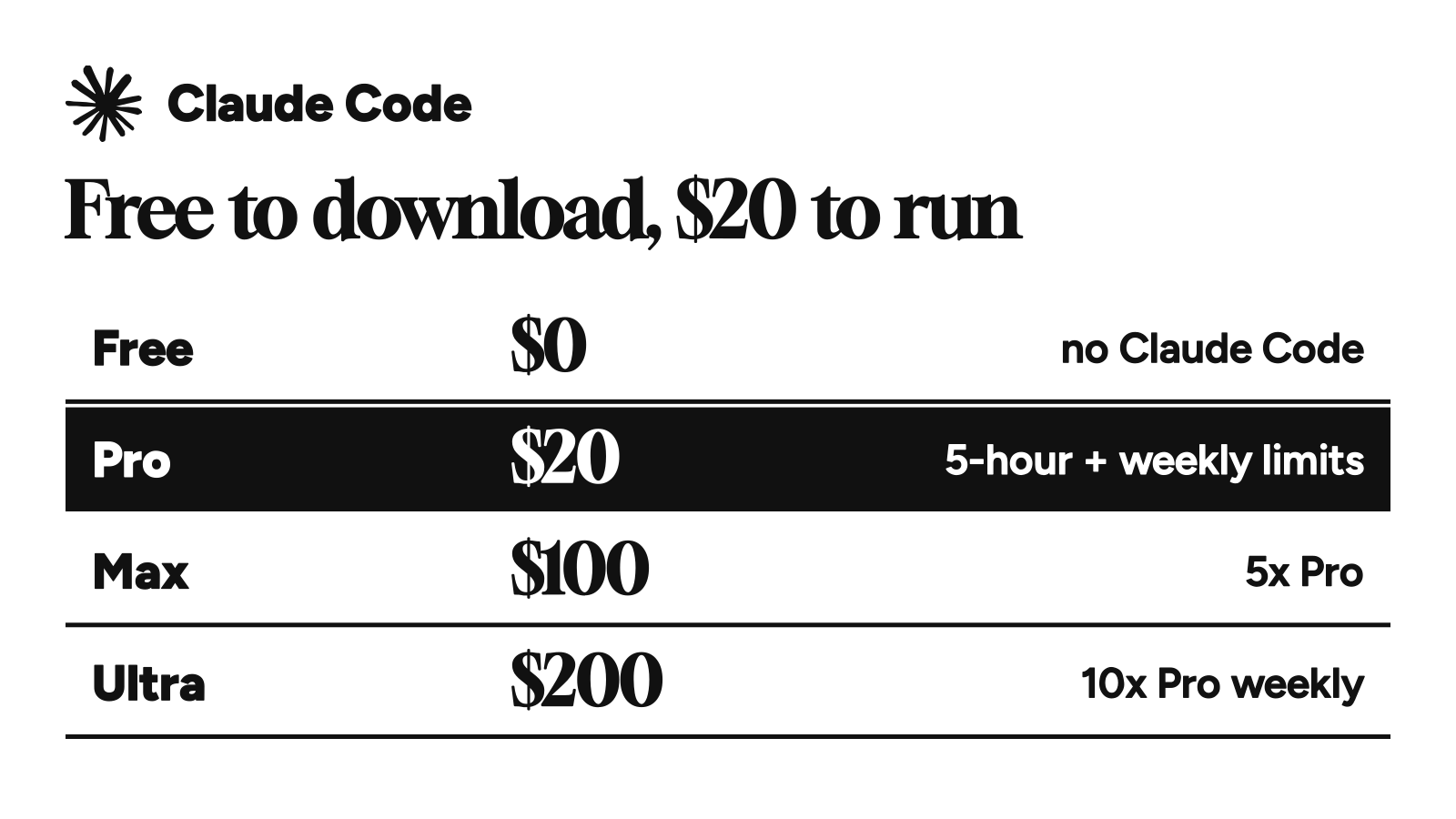
No, it isn’t free. The Free plan doesn’t include Claude Code, so you need a paid plan or a Console API key. Claude Code costs $20 a month on Claude Pro ($17 a month if you pay $200 for the year), $100 on Claude Max, and $200 on Claude Ultra, which Anthropic renamed from Max 20x on October 30, 2026 (pricing page).
- Cheapest way in: Claude Pro covers Claude Code in the terminal, VS Code, JetBrains, the desktop app, the web, and the Claude mobile app.
- What $20 buys: About 2.9B tokens a month on Pro on an agent workload, worth about $1,178 at Opus 5.5 API rates. Here’s how that compares with ChatGPT Plus.
- When to pay $100 or $200: Max gives you 5x Pro’s usage every 5 hours and every week. Ultra gives you 10x Pro’s weekly usage and drops the 5-hour limit.
- The API credit catch: Max and Ultra come with $100 or $200 a month in Claude Platform API credits, but those are for apps you build on the API. You can’t spend them in Claude Code or the Claude apps, and unused credits expire every billing cycle.
Prices checked November 9, 2026.
Claude Code Subscription Plans and Pricing: Pro, Max, Ultra, and API
Five plans include Claude Code, or you can skip the subscription and pay per token through the Claude Console.
| Plan | Price a month | Claude Code limits |
|---|---|---|
| Claude Free | $0 | Not included (chat only, on Sonnet and Haiku) |
| Claude Pro | $20 ($17 yearly) | 5-hour and weekly limits |
| Claude Max | $100 | 5x Pro, every 5 hours and every week |
| Claude Ultra (formerly Max 20x) | $200 | 10x Pro weekly, no 5-hour limit on verified accounts |
| Claude Team | $25 / $125 per seat ($20 / $100 yearly) | 1.25x / 6.25x Pro per session |
| Claude Enterprise | $20 per seat yearly, plus API-rate usage | Billed by usage |
| API key (Console) | Pay per token | No 5-hour or weekly limit |
- Models: every plan with Claude Code gets Opus 5.5, Sonnet 5.5, and Haiku 5.5. Fable 5.1 can use up to half the weekly limit on Max, Ultra, and Team Premium; on Pro it runs only on usage credits.
- Over the limit: turn on usage credits and keep going at API rates. Team and Enterprise admins can cap spend.
- API credits: Team gets up to $500 a month pooled; like Max’s and Ultra’s, they don’t work in Claude Code. Console credits you prepay expire a year after purchase.
Claude API Rates for Claude Code
If you sign in with a Console API key instead of a plan, every token is billed at these rates (API pricing):
| Model | Input (per 1M tokens) | Output (per 1M tokens) | Cache read (per 1M tokens) | Fast mode (input/output) |
|---|---|---|---|---|
| Fable 5.1 | $10 | $50 | $0.25 | N/A |
| Opus 5.5 | $4 | $20 | $0.20 | $8 / $40 |
| Sonnet 5.5 | $2 | $10 | $0.10 | N/A |
| Haiku 5.5 (prompts up to 100K tokens) | $0.10 | $0.50 | $0.01 | N/A |
| Haiku 5.5 (prompts over 100K tokens) | $0.50 | $2.50 | $0.05 | N/A |
Web search on the API adds $10 per 1,000 searches. Plans don’t bill it separately.
What a Month of Real Work Costs
Every time Claude Code reads a file, runs a test, or edits a module, it sends your whole conversation back to the model. A long session re-sends the same prefix hundreds of times.
On the API, you pay for every one of those sends. Prompt caching softens it (an Opus 5.5 cache read costs 5% of the input rate), but it still adds up fast.
That’s why the subscription wins for almost every solo developer. Run SemiAnalysis’s numbers and each plan pays for itself once you’d use about 1.7% of its allowance. Past that, every token is cheaper on the plan than on the API. And the rate barely moves between tiers—a bigger plan buys a bigger bucket at about the same price per token.
Anthropic publishes its own yardstick for API-billed use. Across enterprise deployments, Claude Code averages about $13 per developer per active day and $150 to $250 per developer a month, and 90% of users stay under $30 a day (Claude Code cost docs). At that average, Pro’s $20 covers less than two active days on the API.
Treat both as estimates. Your mix of models and cache hits will move them.
Claude Code Usage Limits by Plan
When you sign in to Claude Code with a Pro, Max, or Ultra plan (run claude, then /login), the terminal and your IDE share one set of limits with Claude on the web, desktop, and mobile:
| Limit | Plans | How it works |
|---|---|---|
| 5-hour window | Pro and Max (and Ultra until verified) | Starts with your first message and resets in full 5 hours later. Hit it mid-response and Claude Code may finish the step it’s on (“Usage limit reached · wrapping up”). |
| Weekly limit | Pro, Max, and Ultra | Covers every model and resets at a fixed day and time assigned to your account. |
| Weekly Fable limit | Max and Ultra | A separate cap on top of the general one. On Pro, Fable runs only on usage credits. |
| Usage credits | Pro, Max, and Ultra | Turn them on in Settings → Usage (or run /usage-credits) and Claude Code keeps going at API rates. Credits bought from December 7, 2026 expire after 12 months. |
Run /usage inside Claude Code to see your plan bars. On Pro, Max, and Ultra it also breaks down what’s eating your allowance (skills, subagents, and MCP servers) and flags anything behind 10% or more of your recent usage.
For how resets work on every Claude, ChatGPT, and Gemini plan, see the AI usage limits guide.
Which Claude Code Plan Fits You
| If you… | Pick | Monthly cost |
|---|---|---|
| Code with Claude a few hours a week, mostly on Sonnet | Pro | $20 ($17 yearly) |
| Hit the 5-hour wall most workdays | Max | $100 |
| Run all-day Opus sessions or parallel agents | Ultra | $200 |
| Need central billing for 2 to 150 people | Team, Premium seats for heavy users | $20–$125 per seat |
| Need SCIM, audit logs, or more than 150 seats | Enterprise | $20 per seat plus API usage |
| Use Claude Code a few times a month, or run it from scripts and CI | Console API key with a spend limit | Pay per token |
Weighing Claude Code against Codex or Cursor instead? See Claude Code vs Codex vs Cursor.
What Claude Code Users Run Into
The API Key That Quietly Takes Over Billing
Anthropic’s own help article says it plainly: Claude Code puts an ANTHROPIC_API_KEY environment variable ahead of your subscription login, and you pay API rates when it does. It happens even if you’re signed in with Pro or Max.
Scripts are where it bites. Claude Code’s authentication docs say that in interactive mode it asks once before using the key, but in non-interactive mode (claude -p) it always uses the key when one is present. So a scheduled job or test script that runs where the key is set bills the API, not your plan.
The fix takes ten seconds. Run /status inside Claude Code to see which login is active, unset ANTHROPIC_API_KEY before any script that launches claude, and rename the variable in projects whose own code needs an Anthropic key. Turning off auto-recharge in the Console caps the damage if you miss one.
How Fast Pro Runs Dry in Claude Code
Pro is the cheapest way in, and coders say it shows. In a late-October r/ClaudeAI thread on whether Max is worth it, the top reply said Pro “runs out fast” for Claude Code: a few hours of steady agent work can use up a 5-hour window, and the weekly cap arrives before the week ends if you code most days.
The same complaint runs through Hacker News and GitHub. A Pro user on HN said their usage jumped three- to fourfold in a week on the same projects, and on GitHub, another lost half the weekly limit in two sessions, even on Sonnet 5.5. Another user in that issue said the drain looked like real usage: mostly long sessions re-reading their own history plus subagents pinned to Opus.
Light use goes a long way, though: on Bluesky, one developer built a painting company’s website on about 3% of the weekly limit. One Reddit subscriber skips the upgrade altogether: they stay on Pro, add $20 of usage credit whenever they hit the limit, and the most they’ve spent that way is $70, still less than the $100 Max plan.
Running two sessions at once doubles the drain, since both pull from one pool.
Ultra’s Weekly Limit, a Week After the Rename
Ultra dropped the 5-hour window, but the weekly limit stayed, and it’s now the wall people hit. An open GitHub issue from the first week of November came from an Ultra subscriber at 91% of the weekly limit about two days after the reset.
Anthropic hasn’t explained it, so treat it as an open bug, not proof of a cut. If you’re thinking about Ultra for all-day sessions, watch the weekly bar in your first few days.
How to Cut Your Claude Code Cost
| Move | Why it saves |
|---|---|
| Use Sonnet 5.5 for routine edits, Opus 5.5 for the hard stuff | Sonnet costs half as much per token, and Anthropic’s cost docs say it handles most coding tasks well. Haiku 5.5 is 40x cheaper than Opus 5.5 on short prompts, which suits quick lookups and boilerplate. |
| Keep your prompt prefix stable | Each model has its own cache, so switching models or MCP tools mid-session makes the next turn re-read everything at full input price. Set up before a long session, not halfway through it. |
| Don’t walk away from a big session on usage credits | On a plan, within your included usage, the main conversation’s cache lasts an hour. On usage credits or an API key it drops to five minutes, so the first message after a coffee break re-processes the whole context. |
Run /clear between unrelated tasks |
Anthropic calls it the single most effective lever for both quality and cost. Use /compact when you need the context to survive. |
| Keep agent teams small | Each teammate runs its own context window. Anthropic puts agent teams at about 7x the tokens of a standard session when teammates run in plan mode. |
| Pair Pro with a cheap backup | When the limits stop you mid-week, sending routine test fixes to OpenCode Go ($10 a month) or Z.ai’s GLM Coding Plan Lite ($18 a month) costs far less than jumping from $20 to $100. More options in the cheapest AI coding plans. |
Claude Code Pricing FAQ
What’s the cheapest way to use Claude Code? Pro on the yearly plan, at $17 a month. If you only open Claude Code a few times a month, a Console API key with a spend limit can come in lower.
Is Ultra unlimited? No. Verified Ultra accounts lose the 5-hour window, but the weekly limit and a separate weekly Fable limit still apply.
My best coding plan tool compares the rest, and coding plan vs API: what a dollar buys runs the same math across vendors.
Start on Pro, keep Sonnet as your workhorse, and move to Max only when the 5-hour wall keeps stopping real work.

Ali Arslan
Ali began his journey as a full-time Tech Journalist in 2021. He’s been a tech enthusiast all his life, starting with a 286 PC gifted to him at the age of 7.
With time, he’s grown into a power user of Android, Linux, Windows, and all things AI, which are the main focus of his writing here at Tech Unbloated. He’s also got a proficient track record for bricking (and sometimes unbricking) Android phones while trying to push the hardware and software to their limits.
Ali has an Advanced Diploma in Business Management from London, UK, and is an English Literature graduate from Punjab University, Pakistan. Other than Tech Unbloated, he’s written for big tech publications like MakeTechEasier, MakeUseOf, How-To Geek, and LimeWire—however, most of his previous work was as a ghostwriter for high-profile clients.
Before becoming a full-time writer, Ali tried his luck at music production, graphic design, teaching, business management, web development, and dropshipping. His writing often reflects all these experiences he’s had in life.
Discussion
Corrections, disagreements, and the thing I missed. Comments are read before they go up.
No comments yet. Go on—be first, and make it count.
Comments stay off until you say so.
Enable comments in cookie preferences to read and join the thread. No login. No ads in the box.