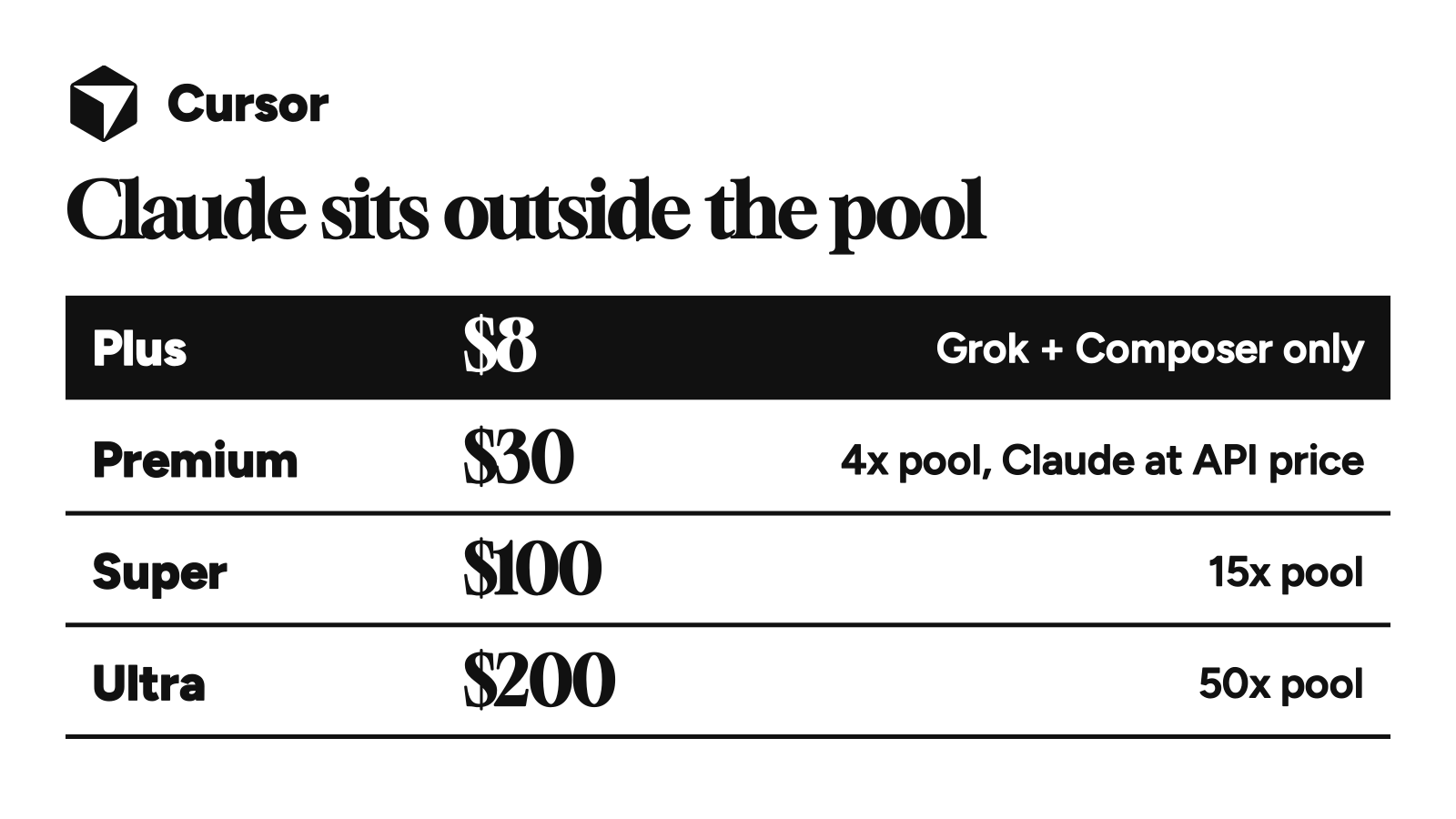
Cursor’s cheapest paid plan is $8 now. But the catch is what that $8 leaves out.
On October 12, 2026, Cursor became part of The X Subscription, one bill for Cursor, Grok, and X. New customers can’t buy the old $20 Pro plan anymore, the one that came with an allowance for Claude and GPT. Every new plan runs on a weekly pool you share with Grok, and Claude, GPT, and Gemini sit outside that pool on all of them.
How Much Does Cursor Cost?
Cursor costs $0 on Free, $8/month on Plus, $30/month on Premium, $100/month on Super, and $200/month on Ultra. Teams seats are $30, $100, or $200 per user per month, and Enterprise is custom.
- What the pool covers: Grok 4.7, Grok 4.6, Grok 4.5, and Composer 2.5, shared between Cursor and the Grok apps and reset weekly.
- What it doesn’t: Claude, GPT, and Gemini. Free and Plus can’t use them at all. On Premium and up, they bill at API list price from prepaid credit, starting with your first request.
- Which tier to buy: Plus if you want Agent on Cursor’s own models. Premium if you need cloud agents, automations, code hosting, AI code reviews, or third-party models.
- Old plans: Pro ($20), Pro+ ($60), Ultra ($200), and the rest keep working for existing customers, with their Claude and GPT allowance. New customers can’t buy them.
Prices checked November 9, 2026.
Cursor Plans and Pricing Compared
Annual billing costs 10x the monthly price, so you get two months free.
| Plan | Price a month | Weekly pool | Claude, GPT, and Gemini |
|---|---|---|---|
| Free | $0 | Limited | Not available |
| Plus | $8 (~$6.67 yearly) | Base | Not available |
| Premium | $30 ($25 yearly) | 4x Plus | API list price from prepaid credit |
| Super | $100 (~$83.33 yearly) | 15x Plus | Same as Premium |
| Ultra | $200 (~$166.67 yearly) | 50x Plus | Same as Premium |
| Teams | $30, $100, or $200 per seat | Each seat matches its tier | API list price plus $0.25 per million tokens on eligible models |
| Enterprise | Custom | Pooled across the organization | Same as Teams |
- Cursor’s own models: Grok 4.7, 4.6, and 4.5, plus Composer 2.5. Plus runs them at fixed settings (Fast off, medium effort, Grok 4.7’s 256K context); Premium and up add Fast mode and effort levels.
- Free and Plus: Free gets Agent, Chat, and Tab completions at limited usage, plus limited Grok Imagine and Grok Build. Plus adds Agent in the editor and CLI, the Grok apps, Grok API access, and X benefits.
- Premium and up: cloud agents and automations, code hosting (Origin), AI code reviews (Bugbot), and Grok Bot. Super adds priority model access at peak times; Ultra adds earliest access to new products and models.
- Teams and Enterprise: Teams adds a shared prepaid balance, centralized billing, and SSO, with no Plus seats. Enterprise adds invoicing, SCIM, and advanced security controls.
Plan details come from Cursor’s pricing page and its Models & Pricing docs. Plus also skips Auto and bring-your-own API keys.
Is Cursor Free?
Yes. Cursor Free costs $0 and replaces the old Hobby plan. Cursor doesn’t publish how much usage it includes, only that it’s “limited,” and it has no third-party models.
When the allowance runs out, you wait or upgrade. I’ve used the $8 plan, and considering its low usage limits, the free tier’s quota must be too little for any serious work.
If you mainly want the editor, Free plus a $20 terminal agent is the cheap setup covered further down.
Cursor Usage Limits in Practice
Your pool resets weekly, and the model you pick decides how fast it drains. Cursor doesn’t say how much each model draws, only that the rates differ. Its prices for usage past the pool hint at the gap: Grok 4.7 costs four times Composer 2.5 per input token (rates in the table further down).
Grok Chat, Imagine, Voice, and Grok Bot all eat from the same pool, so a heavy week in the Grok app leaves less for coding. The Grok API is the exception. It bills separately and never touches the pool.
You can check what’s left under Usage at grok.com/dashboard, or in your editor settings.
What People on the New Plans Are Running Into
Cursor’s “at least twice the usage” line hasn’t landed well with everyone. Four days after launch, a user tallied the official announcement thread: about 167 posts from roughly 90 people. The top complaints were the missing Claude and GPT allowance (about 15 users), a pool that runs out faster than the old one (about 14), and not wanting Grok and X bundled in at all (about 10).
- Grok Bot eats the same pool. One Premium user who logs their tokens posted four weeks of numbers on November 4. They got about 399 million tokens a week on the old $20 plan, and their weekly total on the $30 plan fell to about 274 million by week four. They call it “napkin math,” but by their count the pool now runs out in one to one and a half days.
- Big prompts drain it fast. On the forum, a Premium user who came from Pro+ saw 10% of their weekly pool gone after two prompts on October 29. On Hacker News, one developer switched to Claude Code after running out of Grok 4.7 usage and called Opus 5.5 “much better.”
- The Grok push is its own complaint. Another HN user who had been happy with Cursor for years moved to Claude Code at work once Cursor “started to force Grok down our throats.”
- Light users are fine. A third HN user stays “extremely productive” on Composer 2.5 with a (now retired) $20 Cursor plan and reaches for Grok 4.7 only when Composer falls short.
None of these posts is a controlled test. They still point the same way, though: if you lean on Grok Bot or run long agent sessions, budget for the pool to run out before the week does.
Third-Party Models: Where the Money Goes
Cursor’s own models hit prepaid credit only once your weekly pool is gone. Claude, GPT, and Gemini bill from the first token:
| Model | Input (per 1M tokens) | Output (per 1M tokens) | Paid from |
|---|---|---|---|
| Composer 2.5 | $0.50 | $2.50 | Weekly pool, then credit |
| Grok 4.7 | $2 | $6 | Weekly pool, then credit |
| Grok 4.7 (Fast) | $4 | $12 | Weekly pool, then credit (Premium and up) |
| Claude Haiku 5.5 | $0.10 | $0.50 | Credit only |
| Claude Sonnet 5.5 | $2 | $10 | Credit only |
| Claude Opus 5.5 | $4 | $20 | Credit only |
| Claude Fable 5.1 | $10 | $50 | Credit only |
| GPT-5.6 Sol | $4 | $20 (promo price through November 21, 2026) | Credit only |
| Gemini 4 Argon | $2 | $10 | Credit only |
(Cursor’s model list stops at GPT-5.6, so there’s no GPT-6 to pick anyway.)
Subagents can run up that bill behind your back. A subagent can run a named third-party model while your picker still says Auto, Grok, or Composer, and Cursor’s usage help page says those calls bill at that model’s list price. Check which model your subagents use before a long session.
The gap gets big fast. Because Cursor charges Anthropic’s list price for Opus 5.5, a fully used Claude Pro month costs about $1,208 on Cursor Premium. On Claude Pro, it’s $20. That’s the maximum-use case, not a typical month, and Claude Code vs Codex vs Cursor has the math.
What Happens When You Run Out
When your weekly pool runs dry, Cursor-model requests pause instead of dropping to a slower or weaker model. You can wait for the reset, which runs on a rolling seven days from when you joined the plan (not at midnight), keep going on prepaid credit that lasts 365 days, or move up a plan.
Claude, GPT, and Gemini stop as soon as your credit or monthly additional usage limit runs out, even if your weekly pool is untouched. Auto Top-up stays off until you turn it on at grok.com/dashboard/billing.
Cheaper Alternatives to Cursor
You don’t have to give up the Cursor editor to avoid paying $30 plus API credit. Keep Cursor Free or Plus for the editor and run Claude Code or Codex ($20 each) in its terminal, so the heavy work lands on a subscription instead of list-price credit.
Want to spend less than $20? OpenCode Go and Z.ai’s GLM Coding Plan start at $10 and $18, and the coding plan finder compares the rest.
FAQ
Can I Still Get the $20 Cursor Pro Plan?
Only if you already have it. Legacy Pro, Pro+, and Ultra keep their Claude and GPT allowance for as long as you stay on them, and Cursor hasn’t set an end date. Switching to The X Subscription is optional, but it’s permanent: Cursor’s help page says Support can’t undo it.
Does Cursor Plus Include Claude?
No. Plus runs only Grok and Composer 2.5. Claude starts at Premium ($30), billed per token from prepaid credit.
Is Cursor Premium Worth It Over Plus?
Only if you need what Plus locks out: cloud agents, Bugbot reviews, Fast mode, or third-party models. For Grok-only coding, Plus at $8 gets you the same models at fixed settings with a quarter of the pool.
Is Cursor Auto Still Free or Unlimited?
No. Plus doesn’t get Auto at all. On Premium, Super, and Ultra, Auto runs in Cost mode, which bills as a Cursor-model request and draws from your weekly pool whichever model answers.
The Balance and Intelligence modes, which can route to Claude or GPT at list price, are for Teams and Enterprise.
Does Cursor Have a Student Discount?
Not a standing one. Cursor’s students page says anyone can start on Free and points to promotions at campus and online events. Older guides that promise free paid access for anyone with a school email are out of date.
How Do I Upgrade, Downgrade, or Cancel?
On The X Subscription, open the Current plan card at grok.com/dashboard/billing. Upgrades apply right away, and downgrades wait for the end of your billing period. Legacy plans are still managed at cursor.com/dashboard/billing, through Stripe.
Buy Plus at $8 for a cheap Grok-powered editor, and send your heavy Claude or GPT refactors to a $20 terminal plan—not to Cursor credit.

Ali Arslan
Ali began his journey as a full-time Tech Journalist in 2021. He’s been a tech enthusiast all his life, starting with a 286 PC gifted to him at the age of 7.
With time, he’s grown into a power user of Android, Linux, Windows, and all things AI, which are the main focus of his writing here at Tech Unbloated. He’s also got a proficient track record for bricking (and sometimes unbricking) Android phones while trying to push the hardware and software to their limits.
Ali has an Advanced Diploma in Business Management from London, UK, and is an English Literature graduate from Punjab University, Pakistan. Other than Tech Unbloated, he’s written for big tech publications like MakeTechEasier, MakeUseOf, How-To Geek, and LimeWire—however, most of his previous work was as a ghostwriter for high-profile clients.
Before becoming a full-time writer, Ali tried his luck at music production, graphic design, teaching, business management, web development, and dropshipping. His writing often reflects all these experiences he’s had in life.
Discussion
Corrections, disagreements, and the thing I missed. Comments are read before they go up.
No comments yet. Go on—be first, and make it count.
Comments stay off until you say so.
Enable comments in cookie preferences to read and join the thread. No login. No ads in the box.