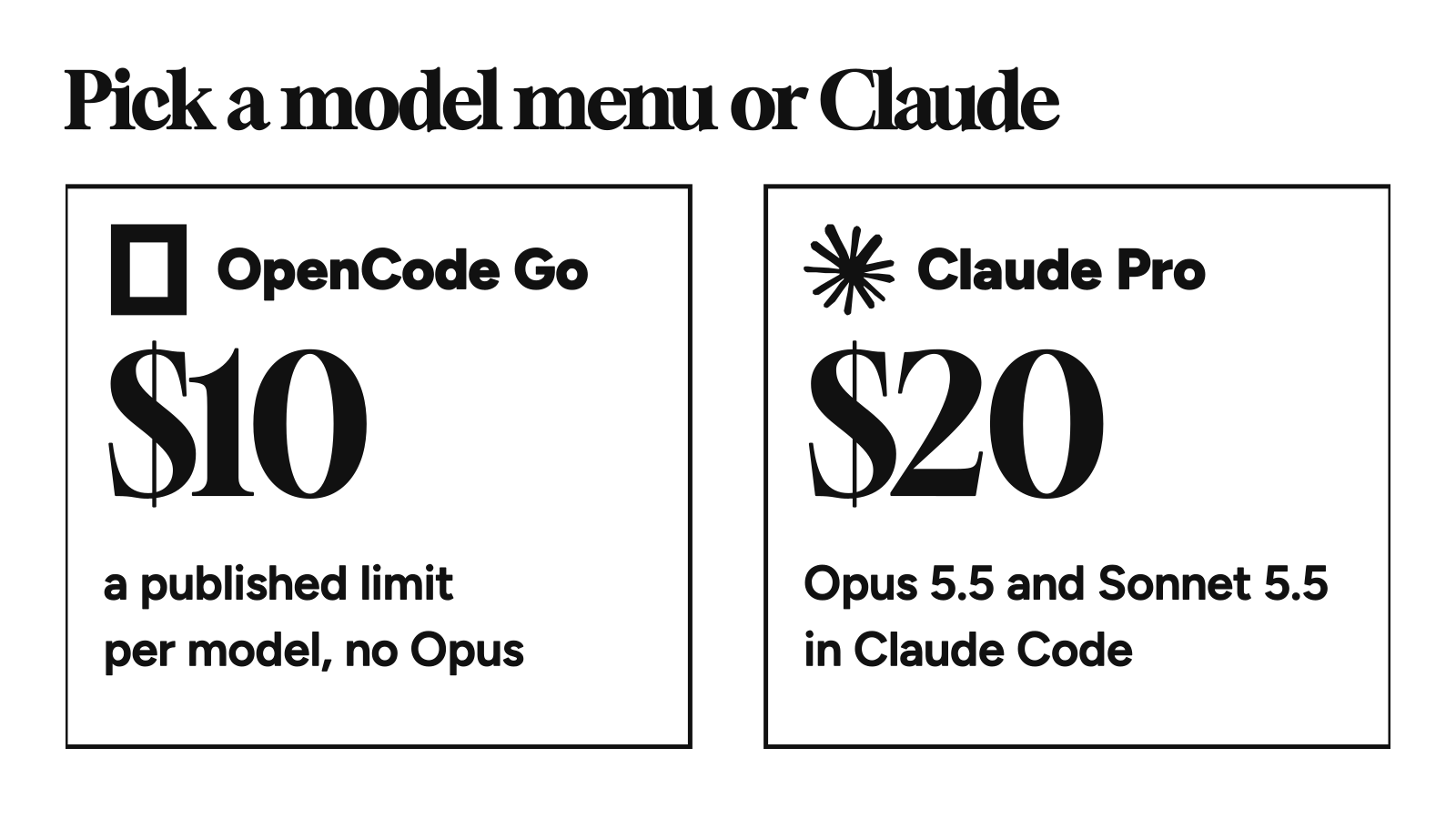
OpenCode vs Claude Code gets confusing fast—“OpenCode” is two things under one roof.
One is a free, open-source coding agent (terminal, desktop, and mobile) that connects to models from 200+ providers. The other is OpenCode Go, a $10-a-month subscription covering 33 models. Claude Code is Anthropic’s closed-source agent, built around Claude Opus 5.5, Sonnet 5.5, and Haiku 5.5, and it starts at $20 a month on Claude Pro.
OpenCode vs Claude Code: The Short Answer
- Pick Claude Code ($20 on Claude Pro) if you want Opus 5.5 or Sonnet 5.5. A subscription buys far more Opus than the same money spent at API rates, and your Pro login only works in Anthropic’s own apps.
- Pick OpenCode with OpenCode Go ($10) for model variety at half the entry price. You get a published limit for every model.
- The catch with Go: it includes Haiku 5.5, but not Sonnet 5.5 or Opus 5.5. Those cost extra, per token.
Prices checked November 9, 2026.
| Feature | OpenCode + OpenCode Go / Go Plus | Claude Code (Claude Pro, Max, or Ultra) |
|---|---|---|
| Agent license | Free, open source (MIT) | Proprietary |
| Subscription price | $10/mo (Go), $40/mo (Go Plus), $20/member/mo (Go Teams) | $20/mo (Pro, $17 billed annually), $100/mo (Max), $200/mo (Ultra) |
| Models on the plan | 33 (four free for a limited time), including Gemini 4 Argon, Grok 4.7, GLM-5.3, Kimi K3.1 Pro, Qwen3.8 Max, Haiku 5.5, DeepSeek V4.1 Flash, and MiniMax M3 | Opus 5.5, Sonnet 5.5, and Haiku 5.5; Fable 5.1 up to half the weekly limit on Max and Ultra, usage credits only on Pro |
| Other models | 200+ providers, including the Anthropic and OpenAI APIs, Z.ai, and local Ollama | Your plan login covers Anthropic’s models only |
| Published limits | A dollar figure per model: $15–$100 a month on Go, $60–$240 on Go Plus, all drawing on one shared allowance | No published numbers; a 5-hour and a weekly limit |
| Value per $1 | 1.5x–6x on most models, 10x on DeepSeek V4.1 Flash | ~$57.25–$58.90 of API value on an Opus 5.5 agent workload (Pro and Max) |
| Refunds | Possible within 14 days if you’ve used almost none of that period’s allowance | Non-refundable unless the terms or local law say otherwise; cancel anytime |
OpenCode Go vs Claude Pro: What Each Costs per Month
The two ladders measure usage in completely different ways.
OpenCode Go and Go Plus. OpenCode skips the mystery usage bar—mostly. It publishes a dollar limit and an estimated request count for every model. Any 5-hour window can use 20% of the monthly allowance, any week 50%.
| Go model | Monthly limit (Go) | Est. requests per 5 hours | Est. requests per month |
|---|---|---|---|
| Gemini 4 Argon | $30 | 440 | 2,120 |
| GLM-5.3 | $15 | 220 | 1,080 |
| Grok 4.7 | $15 | 169 | 845 |
| Qwen3.8 Max | $15 | 160 | 810 |
| Kimi K3.1 Pro | $15 | 147 | 735 |
| Claude Haiku 5.5 | $15 | 3,850 | 19,230 |
| MiniMax M3 | $60 | 3,200 | 16,000 |
| DeepSeek V4.1 Flash | $100 | 43,330 | 216,670 |
Each estimate assumes you spend the whole allowance on that one model.
Go Plus ($40) raises the limits, and unevenly: GLM-5.3 jumps from $15 a month to $120. If you’d rather not subscribe, OpenCode’s pay-as-you-go side (it used to be called Zen) bills per token, plus a processing fee of 4.6% + $0.31 on each credit purchase. For a model-by-model read of Go’s quotas, see GLM Coding Plan vs OpenCode Go.
Claude Code on Pro ($20), Max ($100), and Ultra ($200). Claude Code comes with paid plans only, so Claude Free won’t run it. Pro has a 5-hour and a weekly limit, and SemiAnalysis measured it at ~2.9B tokens a month on an agent workload, about $1,178 of Opus 5.5 at API prices.
Max is 5x Pro every 5 hours and every week. Ultra is 10x Pro weekly, with no 5-hour limit on verified accounts.
The Go Limit Most People Misread
Those per-model dollar figures aren’t separate buckets. Hit the limit on one paid model and every paid model stops.
A user reproduced it on GitHub on October 29: their 5-hour counter hit 100% with no single model anywhere near its listed limit, and every paid model returned “Go usage limit exceeded” until the window reset. OpenCode’s reply in the thread agreed the docs don’t match the service and pointed to support’s answer in an earlier issue: all paid models draw from one shared allowance, and each model’s listed limit sets how heavily it counts.
A $15 model burns that allowance four times faster than a $60 model. A docs fix describing it that way was still open on November 9.
It catches people fast. On November 7, a user opened an issue after hitting the 5-hour limit in about 20 minutes on Kimi on medium effort.
In practice: the pricey $15 models (Kimi K3.1 Pro, Qwen3.8 Max, Grok 4.7, GLM-5.3) drain Go fastest (trust me, I tried them). The $60 and $100 models stretch it (almost impossible to hit the limits, at least for me). When you do hit the wall, the free models keep working.
OpenCode Go Models vs Claude Code Models: Choice and Lock-In
OpenCode doesn’t care whose model you run. Go’s lineup runs from Grok 4.7 and Gemini 4 Argon to DeepSeek V4.1 Flash, Qwen3.8 Max, and a rotating set of free preview models. You can also plug in a Z.ai GLM Coding Plan or local Ollama models.
Claude Code is built around Claude. It’s tuned for Opus 5.5, Sonnet 5.5, and Haiku 5.5, and your plan login covers only those. It works the other way, too: OpenCode lists Claude Code as a validated client for Go, so you can point Claude Code at Go’s models—on a second bill.
Moving over is mostly painless. XDA’s Nolen Jonker (a former colleague of mine), who swapped Claude Code’s desktop app for OpenCode’s this month, found OpenCode picked up their Claude Code skills folder on its own. One catch is that OpenCode 2.0 dropped its CLAUDE.md fallback and reads only AGENTS.md, so copy that file across.
OpenCode vs Claude Code Features Compared
Under the hood, the two agents now share most of the same parts: skills, MCP servers, subagents, and a plan mode. The differences are in where they run and how much they guard by default.
| Feature | OpenCode | Claude Code |
|---|---|---|
| Where it runs | Terminal, desktop, and mobile apps, plus an extension for VS Code, Cursor, and other VS Code forks | Terminal, VS Code, JetBrains, desktop app, and the web |
| Project instructions | AGENTS.md |
CLAUDE.md |
| Skills | Yes | Yes |
| MCP servers | Yes | Yes |
| Subagents | Built-in General and Explore, plus your own, each in a child session | Built-in Explore, Plan, and general-purpose, plus your own |
| Plan before editing | Plan agent, which can’t edit normal project files | Plan mode |
| Plugins | JavaScript or TypeScript packages from npm or a local folder | Bundles of skills, agents, hooks, and MCP servers from a marketplace, via /plugin |
| Default permissions | The Build agent runs tools without asking; it asks before reading .env files |
Asks before most file edits, shell commands, and network requests (Manual mode) |
| Shell sandbox | None; shell commands run with your user account’s full file, process, and network access | Optional OS-level sandbox, off until you run /sandbox |
| Undo | /undo and /redo roll back the last message and its file changes |
/rewind or Esc twice restores code, conversation, or both from any recent prompt |
| Compiler feedback | Built-in language servers feed errors back to the agent after each edit | The same, once you install a code intelligence plugin for your language |
Claude Code ships more guardrails out of the box. OpenCode starts permissive, so tighten its permission rules before you point it at a repo with secrets in it.
Where Each One Breaks Down
OpenCode, if you want Opus or Sonnet. You pay per token for both. Gemini 4 Argon’s $30 Go limit also rests on a 50% token discount that ends November 30, 2026. By my math, the same allowance buys about half as many Argon requests after that.
Switchers keep describing the same trade. In a late-October r/opencode thread weighing Go against Claude Pro, the most common answer was to get both: one reply said to use Claude for hard tasks and hand “the menial ones” to DeepSeek V4.1 Flash on Go. The person who asked went with Claude and called it “a beast” that finishes in one prompt what Antigravity and OpenCode’s free models took several prompts to do.
Developer Joe Karlsson, who moved his default agent to OpenCode in October, now sends most work to DeepSeek V4.1 Flash for about two cents a task and keeps Claude for “the hardest problems.” He also found OpenCode needed more setup to match what Claude Code did quietly, like making the agent run its code before calling a task done.
Hacker News and Bluesky land in the same place. In a November Ask HN thread on agent setups, several developers run a $20 Claude plan next to a $10 or $40 Go plan, and two of them use Claude to plan while Go’s cheaper models do the bulk of the work. On Bluesky, Tedium editor Ernie Smith said Claude Pro and Go covered most of an AI side project, and hitting Go’s weekly limit cost him under $10 extra.
Claude Code, once you hit a limit. With nothing between $20 Pro and $100 Max, Pro’s wall hurts more. One reply in that r/opencode thread said Claude “eats usage very fast.”
Go has its own version of that wall. In the same thread, a Go user said DeepSeek V4.1 Flash is “basically unlimited” if you don’t run it around the clock, but every other model eats the allowance much faster. Which plan lasts longer depends on which model you run.
Which One to Use
- Claude Code on Pro ($20) if Opus 5.5 and Sonnet 5.5 are the models you want for hard refactors and debugging.
- OpenCode with Go ($10) if you want an open-source agent, a spread of non-Anthropic models, and you’re happy living on the cheaper ones.
- Both, for $30. Claude Code for architecture and deep debugging, Go as the multi-model workhorse and backup—so one Claude limit doesn’t shove you into a $100 tier.
The coding plan finder compares current plans if you want a third option.
FAQ
Can OpenCode Use My Claude Pro Subscription?
No. Anthropic’s Claude Code legal page says subscription sign-in is meant for Claude Code and Anthropic’s own apps, and third-party developers may not offer Claude.ai login in their tools. In OpenCode, Claude models need an Anthropic API key or OpenCode’s pay-as-you-go balance.
Is OpenCode Free?
The agent is free and open source. OpenCode also has free models with a daily request limit; Go is the paid add-on with much higher allowances.
How Do I Check My OpenCode Go Usage?
Open the Usage dialog in the desktop or web app, or the Go page in the OpenCode Console. Both show your 5-hour, weekly, and monthly windows as a percentage used, with reset times. In the terminal app, /usage doesn’t show the Go windows yet.
Pay $20 for Claude Code if Opus is the point. Pay $10 for Go if it isn’t—and keep it on the cheap models, where the allowance actually lasts.

Ali Arslan
Ali began his journey as a full-time Tech Journalist in 2021. He’s been a tech enthusiast all his life, starting with a 286 PC gifted to him at the age of 7.
With time, he’s grown into a power user of Android, Linux, Windows, and all things AI, which are the main focus of his writing here at Tech Unbloated. He’s also got a proficient track record for bricking (and sometimes unbricking) Android phones while trying to push the hardware and software to their limits.
Ali has an Advanced Diploma in Business Management from London, UK, and is an English Literature graduate from Punjab University, Pakistan. Other than Tech Unbloated, he’s written for big tech publications like MakeTechEasier, MakeUseOf, How-To Geek, and LimeWire—however, most of his previous work was as a ghostwriter for high-profile clients.
Before becoming a full-time writer, Ali tried his luck at music production, graphic design, teaching, business management, web development, and dropshipping. His writing often reflects all these experiences he’s had in life.
Discussion
Corrections, disagreements, and the thing I missed. Comments are read before they go up.
No comments yet. Go on—be first, and make it count.
Comments stay off until you say so.
Enable comments in cookie preferences to read and join the thread. No login. No ads in the box.