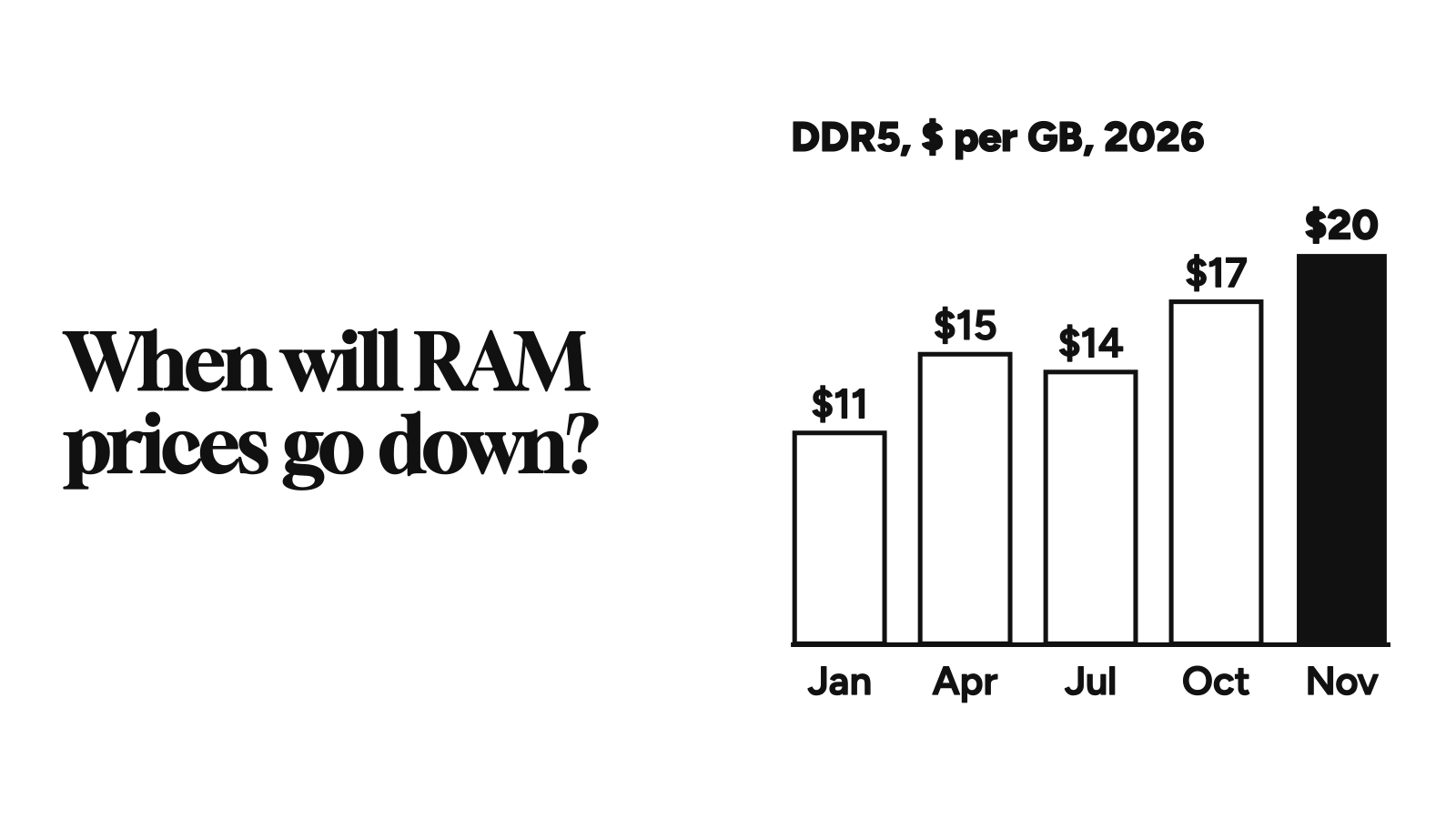
In October 2025, a 32GB kit of DDR5 cost somewhere between $100 and $200. Today the same 32GB works out to roughly $590 at RamRadar’s median asking price.
So when will RAM prices go down? Not soon. Micron, Samsung, and SK hynix all told investors this fall that the shortage runs through 2027 or longer, and the analysts tracking contract prices expect another rise in early 2027.
Quick Answer
- When prices fall: Nobody has named a date, and the big new fabs don’t produce until 2028 or later.
- Next few months: Up. TrendForce expects contract prices to rise 10–15% this quarter and speed up in early 2027.
- Why: Memory makers are moving production to AI servers, which pay far more per chip than your laptop does.
- Buy or wait: If you need the RAM this year, waiting is a bet against every forecast below. If you don’t, don’t buy at these prices.
Prices and forecasts checked November 16, 2026.
When Will RAM Prices Go Down?
Nobody who makes memory is predicting a drop. The latest statements, from each company’s earnings release or the analyst’s press release:
| Who | When they said it | What they said |
|---|---|---|
| TrendForce | Sept 30, 2026 | Conventional DRAM contract prices rise 10–15% quarter over quarter in Q4 2026; PC DRAM supply “could decline in 2027” as capacity shifts to servers |
| TrendForce | Nov 6, 2026 | DRAM price increases “expected to gain further momentum in 1Q27” |
| TrendForce | Nov 11, 2026 | PC DRAM contract prices rise 13–18% in Q4 2026, slower than last quarter; memory makers “tentatively plan cuts to PC DRAM supply in 2027” |
| Micron | Sept 30, 2026 | Supply and demand “much tighter” in fiscal 2027 and 2028 than in 2026; “we do not have line of sight to when supply and demand will return to balance” |
| SK hynix | Oct 28, 2026 | Expects demand to exceed supply “through 2030” |
| Samsung | Oct 29, 2026 | In 2027, AI-driven demand will “far exceed the industry supply in comparison with 2026” |
| Counterpoint Research | Nov 5, 2026 | Prices “should stay strong next year”; supply stays tight “because major new fabs will not start production until 2028” |
Those are forecasts from people who sell memory, or sell research to people who do. The factory dates are harder to argue with.
In its prepared remarks, Micron says its Idaho fab starts wafer output in mid-2027, its second Idaho fab and its Japan expansion in late 2028, and its first New York fab in 2030. New fabs then take “a few quarters” after first output before production becomes meaningful.
PC builders got there without the earnings calls. When a first-time builder on r/buildapc asked in September whether to wait a month or two for RAM to drop, the thread drew almost 200 replies, and the answer was no. One of the top-voted ones said prices drop on “the second Tuesday of never,” and the serious ones guessed 2029 at the earliest.
My read: real relief for desktop and laptop RAM looks like a 2028 story at the earliest.
What Could Make Prices Fall Sooner
| What could change | Where it stands in November 2026 |
|---|---|
| AI spending slows | TrendForce’s October 20 news roundup lists the sustainability of AI capital spending among the industry’s open worries. If the big cloud companies cut orders, the whole forecast falls over. |
| PC demand drops | TrendForce’s November 11 note says notebook shipments fell 15.8% in Q3 2026 and PC makers are sitting on unsold stock. So far that has slowed the price increases, and they’re still increases. |
| Chinese supply (CXMT) | CXMT has announced a denser 4F² DRAM design, but industry sources quoted by TrendForce expect full commercialization after 2028, and analysts see “limited near-term pressure on prices.” |
| Price caps in contracts | Some long-term agreements signed from Q2 2026 onward include price caps, and the Commercial Times report TrendForce quoted names those caps as one reason increases are slowing. |
Some builders are betting on the first one. On Hacker News in August, one commenter called this the fourth or fifth memory boom-and-bust and predicted AI buyers will cancel orders, ending with “$50 for 32GB-64GB of DDR5 in 2029.” Even that optimist puts the drop years out.
How You’ll Know Prices Are Really Turning
A slower increase isn’t a drop, and one cheap kit isn’t a trend. Watch these, roughly in the order they move:
| Signal | Where to check | Where it stands today |
|---|---|---|
| Contract-price forecast goes flat or negative | TrendForce’s quarterly DRAM guidance | Still rising, and speeding up into Q1 2027 |
| Spot chip prices fall several weeks in a row | DRAMeXchange’s spot page (explained below) | No streak yet |
| Memory makers stop calling supply “tight” | Micron, Samsung, and SK hynix quarterly results | Not yet |
| Retail price per GB falls for a month or more | RamRadar’s index (below) | Flat: DDR5 up 1% in 30 days, DDR4 down 1.4% |
| Discounts across several brands at once | Retailer listings | One-off deals that sell out fast |
The first two lead. Retail prices lag, because stores sell through stock they bought at the old price before they reprice.
Why Is RAM So Expensive Right Now?
Think of a memory fab like a bakery with a fixed number of ovens. For years it baked bread for everyone. Then a customer showed up who pays wedding-cake prices for every oven it can get—and keeps ordering more.
That customer is AI. TrendForce estimates that HBM and server RDIMMs (the memory in AI and cloud servers) take 51% of all DRAM bit supply in 2026. Server DRAM contract prices rose 64% in the second half of 2025, and TrendForce expected roughly another 270% across 2026.
Ordinary server memory is squeezed too. Counterpoint says AI racks now pair more CPUs with each GPU, and those CPUs need ordinary DDR5. In Nvidia’s Vera Rubin rack, CPU memory per socket rises to 1.5TB, almost three times the previous generation.
Meanwhile, the makers aren’t producing much more. Counterpoint found DRAM bit shipments rose only about 4% in Q3 2026, while DRAM revenue reached nearly $200 billion, close to five times a year earlier. Its analyst called it “a pricing super-cycle, not yet a volume cycle.”
And one big consumer brand left the shelf entirely. Micron said in December 2025 that it would stop shipping Crucial consumer products after February 2026, explaining that it wanted to “improve supply and support for our larger, strategic customers.”
RAM Prices: Where They Stand This Month
RamRadar’s RAM Price Index tracks the lowest listed price for each in-stock kit at eBay and Newegg, in US dollars per gigabyte. These are asking prices, not confirmed sales:
| Average price per GB | Jan 1, 2026 | Apr 1, 2026 | Jul 1, 2026 | Oct 1, 2026 | Nov 16, 2026 |
|---|---|---|---|---|---|
| DDR5 desktop (DIMM) | $10.71 | $14.70 | $13.80 | $17.36 | $19.82 |
| DDR5 laptop (SODIMM) | $8.84 | $12.12 | $11.40 | $15.49 | $15.91 |
| DDR4 desktop (DIMM) | $6.10 | $8.74 | $7.03 | $7.52 | $8.48 |
| DDR4 laptop (SODIMM) | $5.30 | $8.12 | $6.94 | $6.67 | $6.65 |
RamRadar daily averages. January figures cover fewer kits (17 to 66 per row) than later months, so treat them as rough.
Desktop DDR5 is up 85% since New Year. Most of the gain since October 1 came in one week: the average jumped about 15% between October 10 and 17, and it has added just 1% in the 30 days since. Before you read that as a turn, remember the summer: every row dipped between April and July, then DDR5 blew past its spring high by fall.
DDR5 and DDR4 RAM Price per Kit
Per-gigabyte numbers are hard to feel, so here’s the math from RamRadar’s November 16 medians ($18.57 per GB for desktop DDR5, $7.81 for desktop DDR4), next to the October 2025 baseline from Tom’s Hardware’s RAM price tracker:
| Desktop kit | October 2025 (Tom’s Hardware) | November 16, 2026 (median × capacity) |
|---|---|---|
| 16GB DDR5 | — | about $300 |
| 32GB DDR5 | $100–$200 | about $590 |
| 64GB DDR5 | — | about $1,190 |
| 16GB DDR4 | — | about $125 |
| 32GB DDR4 | $60–$90 | about $250 |
| 64GB DDR4 | — | about $500 |
Rough figures from the median, not quotes for a specific kit. A sale or a slower kit can come in well under them.
Builders’ own receipts line up with that. In a September r/buildapc thread with about 1,500 upvotes, the poster pointed out that 32GB of DDR5 now costs CA$550, what their whole build cost five years ago. A UK commenter in the other r/buildapc thread said they paid £350 for a 32GB DDR5 kit not long before, and the same kit was closer to £400 on Amazon by late September.
What “DRAM Price” Means (Contract vs. Spot)
When TrendForce says “DRAM prices,” it usually means contract prices: what PC makers, phone makers, and cloud companies pay memory makers in negotiated deals. Retail kit prices follow those with a lag.
The spot price is the open market for chips, and it’s jumpier. On November 16, DRAMeXchange’s session average for one 16Gb DDR5 chip was $60.33, with quotes ranging from $45.30 to $72 in a single day. That spread tells you how little loose supply is floating around.
Weirder still, the older chip costs more. The same day, one 16Gb DDR4-3200 chip averaged $79.38.
Is DDR4 a Way Around the Shortage?
Only if you already own a DDR4 machine. At retail it’s still cheaper per gigabyte (see the kit table). The rest of the picture is less friendly:
| Desktop DDR4 | Desktop DDR5 | |
|---|---|---|
| Retail change, last 90 days (RamRadar average) | +12% | +34% |
| Spot price per 16Gb chip, Nov 16 | Higher than DDR5 | Lower than DDR4 |
| Platforms that take it | AMD AM4 (Ryzen 1000–5000), Intel LGA1151 and LGA1200, DDR4 versions of 12th–14th gen Intel boards | AMD AM5, Intel LGA1851, DDR5 versions of 12th–14th gen Intel boards |
| Production | Being wound down as makers move capacity to DDR5 and HBM | Where conventional capacity is going |
So DDR4 is climbing more slowly, but it’s a shrinking part with a chip price already above DDR5’s. For an AM4 or older Intel box, extra DDR4 is still one of the cheapest meaningful upgrades.
For a new build, skip it. Every current mainstream platform needs DDR5, and Tom’s Hardware argues a new DDR4 build makes little sense given which processors and motherboards are still available.
Should You Buy Now or Wait?
Every forecast above points up—so waiting only pays if you don’t need the RAM.
| Your situation | Buy now or wait? | Why |
|---|---|---|
| 8GB laptop or desktop that swaps all day (office work, a browser with 30 tabs) | Buy the 16GB upgrade now, if you have a free slot or a SODIMM machine | It’s the cheapest jump in absolute dollars, and nothing in this market says it gets cheaper next quarter |
| 16GB to 32GB for coding, VMs, or local AI models | Buy only if the limit costs you work today | Upgrading “to be safe” is an expensive insurance policy. Check whether a lighter model or fewer containers gets you by first |
| New gaming or workstation build | Price the RAM first, not last | 32GB of DDR5 is now a big line in the budget (see the kit table) |
| No real need, just curious | Wait | You lose nothing by holding off, and you skip paying peak-cycle money for headroom you won’t use |
That last group is big right now. Several commenters in the CA$550 thread said they’re sitting on 16GB or 32GB DDR4 machines longer than planned. One upgraded the CPU and GPU on an older DDR4 platform instead of moving to a new DDR5 build, and another said they’d buy a decent 32GB kit at $200 to $300 but not at the $600 they were seeing.
Not sure memory is what’s slowing you down? Task Manager will tell you before you spend anything.
If you do buy, read the spec line, not just the price. Speed (DDR5-5600 vs. 6000) and latency (CL40 vs. CL30) vary a lot between kits of the same size.
Don’t count on Black Friday either. Tom’s Hardware notes that good DDR5 deals are scarce and often sell out within seconds of appearing, and one r/buildapc commenter warned that stores can raise prices before a “sale” to make the discount look bigger.
Is Your Machine Even Upgradeable?
Check before you compare kits. Plenty of laptops have memory soldered to the motherboard, and no price drop helps with that.
| Platform | How to check | What to look for |
|---|---|---|
| Windows | Press Ctrl + Shift + Esc for Task Manager, then Performance → Memory (as XDA’s RAM guide walks through) | Slots used: “2 of 4” means you can add sticks, “2 of 2” means you replace them. Form factor: DIMM is a desktop stick, SODIMM is a laptop stick, and “Other” may mean soldered |
| Linux | Run sudo dmidecode --type memory |
Every slot with its size, type (DDR4 or DDR5), speed, and form factor, so empty slots show up next to the filled ones |
| Mac (Apple silicon) | Apple menu → About This Mac | Nothing to upgrade. Apple says memory in its M-series Macs is integrated into the chip package and can’t be upgraded; you pick it at purchase |
If you’re shopping for a new laptop instead, look for SODIMM slots or CAMM2. CAMM2 is the JEDEC standard for replaceable DDR5 and LPDDR5X modules, and its LPCAMM2 version lets thin laptops use fast LPDDR memory without soldering it down.
What Builders Are Saying
Across Reddit, Hacker News, the Linus Tech Tips forum, and Bluesky, most builders land in the same place: if you need RAM now, don’t wait for a drop.
| Where | The common view |
|---|---|
| Most r/buildapc replies expect relief in years, not months (above). | |
| Hacker News | Split between bust-is-coming optimists and people stuck where they are. One October commenter still on a 2017 build wants to double their RAM, but the same DDR4 sticks now cost more than they did in 2017. |
| Linus Tech Tips forum | In an October “RAMageddon” thread, the advice was blunt: don’t buy before you need it, keep a working DDR4 machine, and be patient while new fabs come online. |
| Bluesky | Plenty of people hope an AI bust crashes prices. One user expects them to come down “very slowly” instead, because RAM makers have “done it before.” |
FAQ
Will RAM Prices Go Down in 2027?
Not according to anyone who sells it. Every forecast in the table above points up for 2027.
Is DDR4 Cheaper Than DDR5 Right Now?
At retail, yes—well under half of DDR5’s price per gigabyte. It only helps if your motherboard takes DDR4. One r/buildapc commenter noticed secondhand DDR4 getting slightly cheaper in September while new DDR5 kept climbing.
Should I Wait for Black Friday to Buy RAM?
Only if you can walk away from a bad price. Otherwise it’s a lottery ticket.
Micron, Samsung, and SK hynix just posted record quarters. When the people selling the RAM say they can’t see the end, believe them.

Ali Arslan
Ali began his journey as a full-time Tech Journalist in 2021. He’s been a tech enthusiast all his life, starting with a 286 PC gifted to him at the age of 7.
With time, he’s grown into a power user of Android, Linux, Windows, and all things AI, which are the main focus of his writing here at Tech Unbloated. He’s also got a proficient track record for bricking (and sometimes unbricking) Android phones while trying to push the hardware and software to their limits.
Ali has an Advanced Diploma in Business Management from London, UK, and is an English Literature graduate from Punjab University, Pakistan. Other than Tech Unbloated, he’s written for big tech publications like MakeTechEasier, MakeUseOf, How-To Geek, and LimeWire—however, most of his previous work was as a ghostwriter for high-profile clients.
Before becoming a full-time writer, Ali tried his luck at music production, graphic design, teaching, business management, web development, and dropshipping. His writing often reflects all these experiences he’s had in life.
Discussion
Corrections, disagreements, and the thing I missed. Comments are read before they go up.
No comments yet. Go on—be first, and make it count.
Comments stay off until you say so.
Enable comments in cookie preferences to read and join the thread. No login. No ads in the box.